Claude for Life Science Teams
Chase the science that was out of reach
Claude works through problems alongside your team with full citations and audit trails, from your first hypothesis to the final submission.

“AI is the single most powerful opportunity BMS has to accelerate our mission for patients. Claude gives us the agentic capabilities, pace of innovation, and security to unlock decades of siloed knowledge for every employee – and to operate fundamentally different as a company in the next decade of biopharma.”

“At Genentech, Claude is helping us reshape day-to-day scientific research and lay the foundation for the autonomous labs of the future. By bringing Anthropic’s frontier reasoning models into our lab workflows, we’re building the infrastructure for autonomous, closed-loop discovery—so our scientists can design, execute, and iterate better and faster than ever to deliver more breakthroughs for patients.”

“In our business, speed matters because patients are waiting for new medicines. That urgency is why we’re using Claude to enhance productivity across our company. By connecting Claude to trusted resources like PubMed through MCP, we’re accelerating literature reviews that once took days, freeing our teams to focus on what matters most: advancing the science and technology that help bring life-transforming medicines to patients in need.”

“The clinical trial of 2030 will be designed by AI, managed by intelligent agents, and continuously optimized in ways that are simply beyond human bandwidth at scale. We’re not waiting for that future — we’re building it now. This is possible partnership works because Evinova and Anthropic are aligned where it matters most: AI in clinical development must be safe, explainable, and accountable. Pairing safety-first frontier AI capability with deep industry transformation experience is what pharma has been waiting for — and what patients deserve.”

“Claude plays an important role in how AbbVie operates—powering our Intelligent Medical Insights to better serve healthcare professionals and anchoring the agentic AI ecosystem behind a rapidly growing set of use cases. With Claude Enterprise, we are now exploring ways to scale that foundation across all of AbbVie to accelerate our mission of delivering innovative medicines to patients around the world.”

“Cepheid, a Danaher company, is using Claude to accelerate how its assay development team drafts and refines regulatory documentation for diagnostics in development—benefiting more patients by moving faster than a traditional release cycle. For the current Ebola outbreak, we're relying on our Xpert Hemorrhagic Fever test which detects the Ebola Bundibugyo strain. Partnerships like the one with Anthropic help Danaher and its operating companies accelerate ideas to impact.”

“At AstraZeneca, AI is a defining force reshaping how we operate across R&D end-to-end. Through R&D powered by AI, we can derive deeper biological insights that help us push the boundaries of science to deliver life-changing medicines, including novel approaches for patient selection. Claude's commitment to mechanistic interpretability provides a safe, secure, and steerable model to empower our science-first approach.”

“By reducing manual burden and enabling greater scale across our operations, our partnership with Anthropic will empower our teams to focus more time on high-value scientific and strategic work, with the goal of accelerating our path to patient impact.”

“Veeva AI is industry-specific agentic AI that leverages Veeva's deep applications, data, domain expertise, and Anthropic's Claude. This unique combination allows us to bring the transformative promise of AI to life sciences at scale.”

“Opus 4.5 is an incredible model and a great choice for computational biology. The model is excellent at coding, reasoning about biology, and understanding scientific figures.”

“Commercial pharma teams are entering an era where real-time clinical intelligence and AI agents fundamentally change how therapies reach the right patients at the right time. Anthropic's models are unmatched in their reasoning capabilities and safety design. This collaboration accelerates our shared mission to ensure that clinical-grade agentic AI becomes a trusted, transformative force across global pharma.”

“Broad Institute scientists pursue the most ambitious questions in biology and medicine, and we create and share tools to help empower scientists everywhere. We’ve been working closely with Manifold on the next generation of the Terra.bio platform—Terra Powered by Manifold. Among the most exciting of these upgrades are AI agents built on Claude that enable scientists to carry out tasks at an entirely new scale and efficiency and explore scientific domains in previously impossible ways.”

“AI in R&D only works through an ecosystem. Anthropic is doing this right, bringing together the best technologies while putting access, governance, and interoperability first. Benchling is uniquely positioned to contribute. For more than a decade, scientists have trusted us as the source of truth for experimental data and to modernize their workflows. Now we're building AI that powers this next chapter of R&D.”

“Claude, paired with internal knowledge libraries, has become integral to Sanofi’s AI-driven transformation and is used by the majority of Sanofians on a daily basis within our internal Concierge app. We are seeing significant efficiency gains across the value-chain by optimizing our processes, while our enterprise-wide deployment has enhanced how our teams work. This collaboration with Anthropic augments human expertise to deliver life-changing medicines faster and more effectively to patients worldwide.”

“We’ve consistently been one of the first movers when it comes to document and content automation in pharma development. Our work with Anthropic and Claude has set a new standard—we’re not just automating tasks, we’re transforming how medicines get from discovery to the patients who need them.”

“Claude Code has become a powerful accelerator for us at Schrödinger. For the projects where it fits best, Claude Code allows us to turn ideas into working code in minutes instead of hours, enabling us to move up to 10x faster in some cases. As we continue to work with Claude, we are excited to see how we can further transform the way we build and customize our software.”

“At Manifold, our mission is to power faster, leaner life sciences. Building with Claude has enabled us to develop AI agents that translate questions in the semantic space of scientists to execution in the technical space of specialized datasets and tools. Together, we’re transforming how life sciences R&D will happen in the years ahead.”

“At PwC, we believe responsible AI isn’t just a technology opportunity—it’s a trust imperative. We’re proud to pair our deep sector insight with Claude’s agentic intelligence to reimagine how clinical, regulatory, and commercial teams operate. Together, we’re not just streamlining processes—we’re elevating quality, accelerating discovery, and building systems where confidence scales alongside innovation.”

“When we set out to create an AI agent that could automate bioinformatics analyses, we focused on three key factors to decide what model provider to use: top-ranking at software development, aligned with life sciences, and support for startups. We evaluated half a dozen platforms, and it became clear that Claude was the standout leader. We’re excited to continue this collaboration and bring cutting-edge AI Agents into the world of biotech research.”

“Claude has been an invaluable progress multiplier for Axiom as we build AI to predict drug toxicity. We’ve used billions of tokens in Claude Code, and use it to write many of our PRs. More recently, Claude agents with MCP servers have become core tools for our scientific work. With the right MCPs, Claude agents can directly query databases and storage services to interpret, transform, and test correlations in data, and help us identify what data and features are most useful for predicting clinical drug toxicity.”

“At EvolutionaryScale, we’re building next-generation AI systems to model the living world. Anthropic’s frontier models accelerate our ability to reason about complex biological data and translate it into scientific insight, helping us push the boundaries of what’s possible in life science discovery.”
“Claude has become the connective tissue across Sanofi. Our internal assistant, Concierge, is powered by Claude and used every day by roughly 60,000 employees — spanning every business unit from R&D to HR to engineering. For our highest-value work, Claude’s models have consistently proven to be the best, and adoption has grown faster than anything we’ve ever deployed.”
AI you can verify
Claude shows the lowest hallucination rates and is built with biosafety guardrails. When you connect to PubMed, bioRxiv, and research databases, claims are traced to their source, so teams can verify before they act.
Built for scientific complexity
Analyze genomic data, synthesize hundreds of papers, and design experiments. With Opus 4.8, Claude shows notable improvements in biology benchmarks including BioPipelineBench, single-cell RNA analysis, and structural biology.
Made for R&D
Claude Science is designed for scientific discovery across research, publication, and analysis. Connect to scientific databases for accurate work.
Prompt
Use the scRNA-qc skill to perform QC and filtering on my raw_feature_matrix.h5 file. Apply standard filtering thresholds: min 200 genes per cell, max 6,000 genes per cell, max 15% mitochondrial content. Generate an HTML QC report with UMAP visualization, filtered h5ad file, and metrics CSV showing cells retained vs filtered.
Connectors

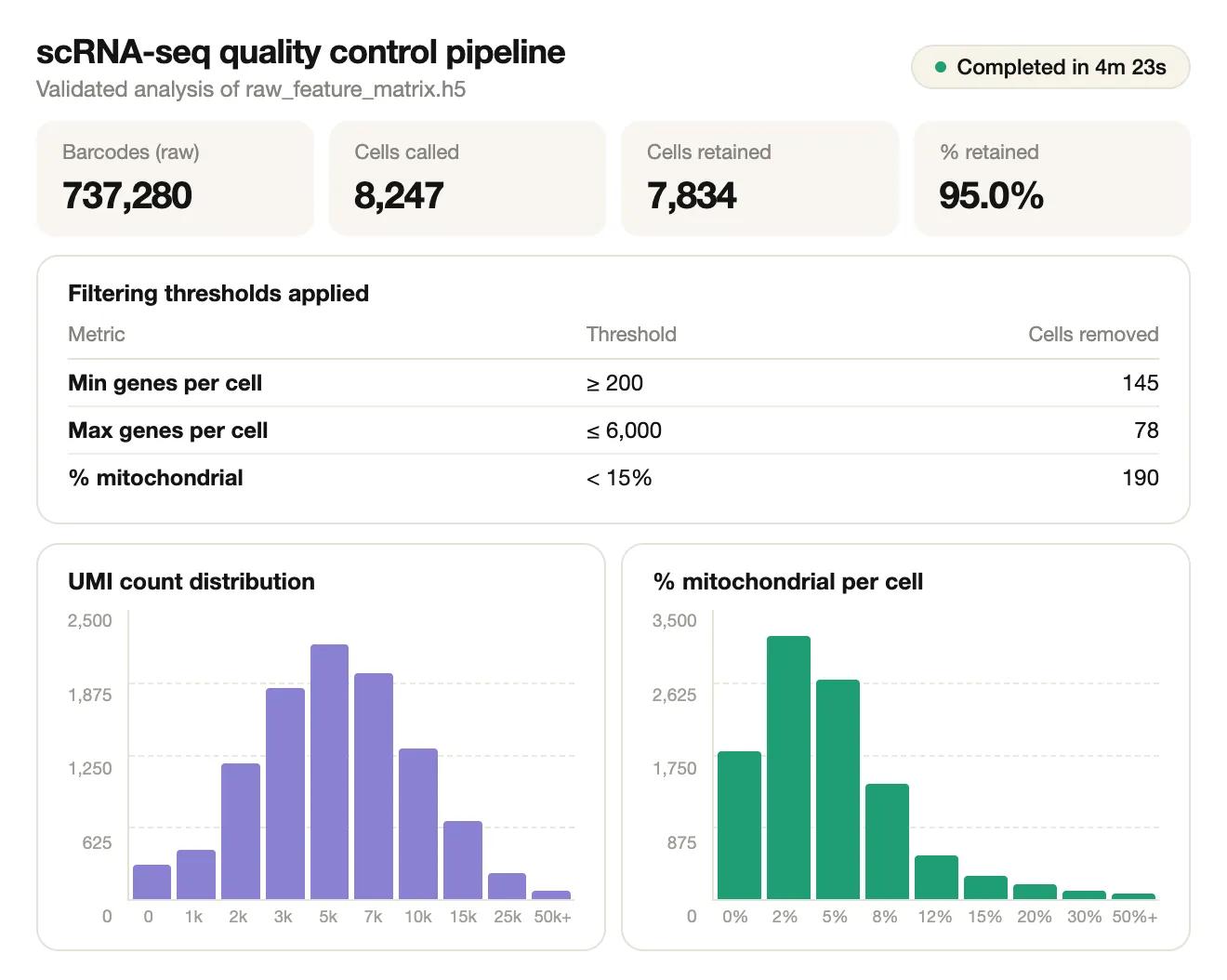 Interactive demo — open this page on a larger screen to try it
Bioinformatics analysis
Process genomic data with validated bioinformatics pipelines through Claude Science. Claude connects to 10x Genomics and Benchling, then delivers annotated, reproducible reports you can share with cross-functional teams without needing to provide complex code.
Research synthesis
Survey hundreds of papers in hours instead of weeks. Claude synthesizes findings across PubMed, bioRxiv, and proprietary databases, identifies contradictions, and generates testable hypotheses with verifiable citations tailored to your research questions.
Clinical trial protocols
Draft clinical protocols with built-in regulatory cross-referencing. Claude researches FDA guidances, analyzes comparable trials on ClinicalTrials.gov, and generates structured protocol drafts ready for review with biostatisticians and regulatory affairs.
Regulatory affairs
Compile structured submissions from clinical and preclinical data with automatic cross-referencing against FDA guidance. Claude flags gaps in your regulatory package before anything ships.
Legacy code modernization
Build life sciences software faster with Claude Code. Claude helps engineers navigate legacy scientific codebases, write robust code for GxP-regulated environments, and catch compliance issues in PR reviews before they ship.
Claude Science works through your research like a skilled biologist, running analysis and tracing every step. Spend less time stitching pipelines together, and more time on science.
Claude Code
Accelerate bioinformatics pipelines and validate scientific software under GxP requirements. Turn computational biology challenges into working code in minutes.
Claude Cowork
Automate routine lab workflows and data processing tasks. Cowork handles repetitive work like data entry and file management so scientists can focus on discovery.
Claude for Microsoft 365
Refine a clinical study in Word, update trial data in Excel, build research presentations in PowerPoint, and do team coordination in Outlook. Claude carries context across it all.





Claude connects to your research ecosystem
Literature, lab notebooks, and analysis platforms, all working together in one place.
Pro
For everyday productivity
- Life sciences connectors and skills
- Access to file creation (docs, slides, spreadsheets, and PDFs)
- Access to research
- Access to Claude Code
- Life sciences guides and docs
Max
Get the most out of Claude
Everything in Pro, plus:
- Choose 5x or 20x more usage than Pro*
- Higher output limits for all tasks
- Early access to advanced Claude features
Usage limits (opens in new tab) apply. Prices shown don’t include applicable tax. Price and plans are subject to change at Anthropic's discretion.
The Team plan for research labs is now available for nonprofits and academic institutions.
Team
For collaboration across organizations
- Life sciences connectors and skills
- Access to file creation (docs, slides, spreadsheets, and PDFs)
- Single sign-on (SSO)
- Central billing and administration
- Includes Claude Code
- Life sciences guides and docs
Enterprise
For businesses operating at scale
Everything in Team, plus:
- More usage*
- HIPAA-ready infrastructure (added cost)
- Enhanced context window
- Compliance API for observability and monitoring
- Single sign-on (SSO) and domain capture
- Custom data retention controls
Usage limits (opens in new tab) apply. Prices shown don’t include applicable tax. Price and plans are subject to change at Anthropic's discretion.
The Team plan for research labs is now available for nonprofits and academic institutions.