Claude for K-12 teachers

Get back to why you started teaching

Focus on students instead of planning, prep, and paperwork. US K-12 educators get free access to premium Claude features, like teaching skills and a connection to evidence-based curricula, aligned to state standards.

Get verified

Trusted by educators alongside

logologo
logologo
logologo
logologo
logologo

Built for K-12 teachers

More time with your students

Ask Claude for a lesson or quiz and it drafts in minutes. You review, adjust, and decide what’s right for your class and get back time to teach.

Grounded in standard curricula

You can connect to Learning Commons, which gives Claude access to academic standards across all 50 states and grounds lesson plans in evidence-based curricula.

Safe with student data

Privacy is a priority. No model training on your content by default and student data stays protected.

Use current teaching tools
thumbnail
Play video

Claude works across the tools you already use to give you faster, more in depth feedback.

Learn more
Next

How educators use Claude

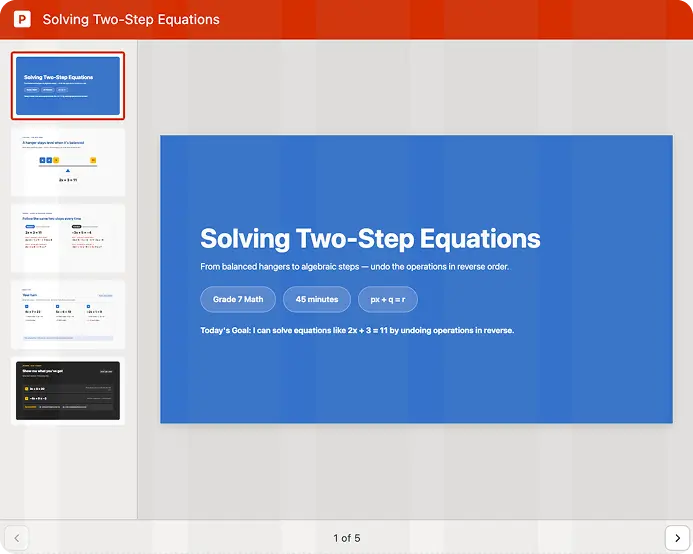
powerpoint

Plan a lesson based on real curriculum

Create new lesson plans, or update existing files on your desktop using Cowork. Claude draws on Learning Commons for state standards and materials from Illustrative Mathematics and OpenSciEd.

mobile

Differentiate for every student in the room

Give Claude context about your class, like reading levels, English language learner status, and specific accommodations. It produces varied materials for students working below, at, and above grade level.

Photosynthesis Check-In

Formative Assessment · 8th Grade Science
Standard: NGSS MS-LS1-6

About this check-in

What this checks (NGSS MS-LS1-6): Can you explain, using evidence, how photosynthesis moves matter (atoms) and energy into and out of living things?

How it works: Part A covers the core ideas. Part B asks you to stretch and explain your thinking. Do your best on every question — this helps your teacher see what to review. It is not graded for points.

Part A — Core Ideas

Level 1 — the building blocks

1. What two things does a plant take IN from its surroundings to carry out photosynthesis?

A. Oxygen and sugar

B. Carbon dioxide and water

C. Sugar and soil

D. Nitrogen and salt

2. Where does a plant get the energy it needs to run photosynthesis?

A. From minerals in the soil

B. From sunlight

C. From the oxygen in the air

D. From the water it drinks

3. Photosynthesis makes a sugar the plant can use as stored food. Which molecule is that?

A. Carbon dioxide (CO2)

B. Water (H2O)

C. Glucose, a sugar (C6H12O6)

D. Oxygen (O2)

4. True or False: “A plant gets most of the material it uses to grow from the soil.” Circle one: TRUE / FALSE

Then explain your choice in one sentence.

5. Fill in the blanks to complete the word equation for photosynthesis:

______+ ______ —(light energy)→ ______ + ______

Hint: Two things go in, two things come out.

Part B — Stretch Your Thinking

Level 2 — explain with evidence

6. A plant absorbs light energy from the Sun. That energy does not disappear — it changes form. Where does the light energy go? Describe what it becomes.

7. A student says: “The carbon atoms in the sugar a plant makes come from the sunlight.” Is the student correct? Explain where the carbon atoms actually come from.

Hint: Sunlight is energy. Atoms are matter. Are those the same thing?

8. A plant is sealed in a clear container in bright light. Over a few hours, the CO2 in the container goes down and the O2 goes up. What does this evidence tell you the plant is doing? Explain how you know.

9. Claim: “Photosynthesis moves both matter and energy.” Support this claim with evidence in 2–3 sentences. (This is the big idea of the whole unit!)

Sentence starters: “Matter moves because…” “Energy moves because…”

10. Explain how the oxygen you breathe is connected to photosynthesis. In your answer, describe matter moving from one place to another.

Answer key and teacher notes

For open-response items, accept any answer that shows the key reasoning below — exact wording will vary. Bracketed tags show what each item reveals about student understanding.

1. B — Carbon dioxide and water [Identifies inputs / matter taken in]

These are the two inputs (reactants) the plant takes in. A, C, and D include products or unrelated substances.

2. B — From sunlight [Distinguishes energy source from matter]

Light is the energy source. Soil minerals and water are matter, not the energy that drives the reaction.

3. C — Glucose, a sugar (C6H12O6) [Identifies the energy-storing product]

Glucose is the food molecule that stores chemical energy. Oxygen is also a product but is not the plant’s stored food.

4. FALSE [Matter: source of plant mass]

Most of a plant’s mass comes from carbon dioxide in the air — the carbon atoms in CO2 become part of the sugar and plant body — plus water, not from soil. Soil mainly provides water and small amounts of minerals. This targets a very common misconception.

5. carbon dioxide + water → sugar (glucose) + oxygen [Reactants and products of photosynthesis]

Accept CO2 + H2O → C6H12O6 + O2. Inputs may be in either order; same for products.

6. Light energy is transformed, not lost [Energy flow and transformation]

The light energy is captured and stored as chemical energy in the bonds of the sugar (glucose) molecules the plant makes. It changes form — light to chemical — rather than disappearing.

7. Student is incorrect [Energy vs. matter; source of carbon]

Sunlight provides energy, not atoms. The carbon atoms come from carbon dioxide (CO2) gas the plant takes in from the air. Full credit distinguishes energy (from the Sun) from matter (carbon from CO2).

8. The plant is doing photosynthesis [Interprets evidence / data]

Falling CO2 shows the plant is using up a reactant (taking in matter); rising O2 shows it is producing a product and releasing it. Together that is evidence of photosynthesis.

9. Claim supported by matter AND energy [Constructs evidence-based explanation — anchor item]

Matter: atoms from CO2 and water are rearranged into sugar and oxygen — the atoms are conserved, just reorganized. Energy: light energy from the Sun is captured and stored as chemical energy in the sugar. A strong answer addresses both matter and energy with evidence. This item is the core of MS-LS1-6.

10. Our oxygen is a product of photosynthesis [Matter cycling across organisms / systems]

Plants release O2 as they make sugar. Those oxygen atoms move out of the plant into the air, and animals (including us) take them in when we breathe. This shows matter cycling between plants and animals.

Quick formative read
  • Part A mostly correct: student has the core inputs and outputs — ready for Part B reasoning.
  • Misses #4 or #7: revisit “where plant mass comes from” and the energy-vs-matter distinction.
  • Weak on #9: reteach how photosynthesis connects matter cycling and energy flow — the MS-LS1-6 target.

Build quizzes and check for understanding

Generate a quiz or short assessment tied to specific standards. Review and adjust before anything reaches students.

email

Draft parent emails and newsletters

With scheduled tasks in Claude Cowork, Claude can draft a classroom newsletter on the cadence and topics that you choose.

Fraction Multiplication

Three common misconceptions in Grade 5 — and questions to surface them

Subject: Mathematics · Grade 5

Topic: Multiplying fractions

Overview

Fifth graders bring three big misconceptions into fraction multiplication, and each one comes from over-applying rules that worked for whole numbers. The diagnostic questions below are designed to bring each faulty mental model into the open during discussion.

1. "Multiplying always makes things bigger."

Years of whole-number multiplication teach kids that products are larger than the factors, so ½ × 8 = 4 feels wrong to them — like it should have been division.

  • "I multiplied two numbers and my answer was smaller than one of them. Did I do something wrong? Why or why not?"
  • "Without calculating, will ¾ × 20 be more than 20 or less than 20? How do you know?"
  • "When does multiplying make a number bigger, when does it make it smaller, and when does it keep it the same?"

2. "You need common denominators to multiply."

Rules from addition leak over. Students who just learned to find common denominators for adding fractions often insist on doing it for multiplication too — or, conversely, they add straight across because multiplying straight across worked.

  • "Jayla says you have to change ⅔ × ¼ into twelfths before you can multiply. Marcus says you can just multiply across.”

3. "× means groups of whole things."

Kids don't yet understand that ⅓ × ½ means "a third of a half." They can execute the multiply-across algorithm without any idea what the answer represents, which is why they can't estimate or check whether an answer is reasonable.

  • "What does ½ × ⅓ mean in words? Can you tell a story problem that matches it?"
  • "Shade ⅓ of a rectangle. Now shade ½ of that piece. What fraction of the whole rectangle did you shade, and how does that connect to the numbers?"
  • "Why is ⅓ of ½ the same as ½ of ⅓? Convince a skeptic with a drawing, not just the algorithm."

A thread across all three

Keep asking students to predict the size of the answer before computing.

That single habit surfaces every one of these misconceptions in discussion, because the wrong predictions come straight from the faulty mental models.

See where students will struggle before they do

Tell Claude your learning objective to unpack the common misconceptions for that topic, along with discussion questions designed to draw them out and correct them.


logo
logo
logo
logo
logo
logo
logo

Connected to services you trust

Claude connects to trusted curriculum sources so you can build lesson plans grounded in your state’s standards.

Explore connectors
AI fluency for K-12 teachers

Access AI Fluency courses co-created with Teach for America and a train the trainer module co-created with the American Federation of Teachers. It’s model-agnostic and practical, includes which classroom tasks AI is suited for, and how to use it responsibly with students in mind.

Start the course

Safe with student data

Protecting student data matters. Claude for Teachers is built to meet that bar.

Learn more

Your data doesn’t train our models

Training is off by default for every verified educator account. Your conversations stay yours.

Built with FERPA in mind

Educator accounts include FERPA-aligned terms and a defined SLA for deleting conversations that contain student data.

Informed by the AFT Gold Standard

Built to the privacy standard set by the American Federation of Teachers for student data protection.

“We’ve been working with Anthropic on a Gold Standard that sets out industry best practices for safety and privacy in K-12 education. It’s important that Anthropic is committing to these principles in their new Claude for Teachers — a tool designed by and for educators to assist them instructionally and hopefully give them more time for the human relationships at the heart of learning.”

Randi Weingarten, President

More tools for K-12 educators

Claude Cowork

Cut down on repetitive work. Set a task up once and Claude handles it on a schedule in Cowork: newsletters, lesson folders, resource lists.

Learn more

Claude Design

Turn lesson ideas into polished materials. Describe a handout, slide deck, or worksheet and Claude builds a design draft. You edit and share what’s right for your class.

Learn more

Claude for Chrome

Research anything without copying and pasting: Claude reads pages on the web in Chrome, pulls the information you need, and compiles it while you work on something else.

Learn more

Claude Skills

Lesson planning and differentiation Skills are already built in. But you can further customize your own Skills — a rubric, your report-card format — and Claude follows it every time.

Learn more
Build performance plans
thumbnail
Play video

Analyze and plan with a holistic view of student performance.

Learn more
Next
How can I help?

Set up a weekly email for parents that includes what the class will learn next week. Highlight how parents can support  students at home.

Ask Claude
How can I help?

Create a series of worksheets on the Bronze Age with space for students to take notes and label tools.

Ask Claude
How can I help?

Pull updated reading comprehension questions for a class discussion on some of the works of Edgar Allen Poe.

Ask Claude
Prev
Next

“Claude surprised me when it broke down my lesson by grade-level standards, suggested accommodations for IEP students, and effectively surfaced interdisciplinary connections!”

Sara, Science Teacher

“As a 9th grade educator seeking tools to reinforce humanist learning, Claude has demonstrated a keen eye towards identifying learning strategies. From classroom simulations, to IEP meeting notes, to the intricacies of lesson planning, strategic application of Claude’s educational tools lets teachers stay in command of the classroom and across systems!”

Justin, Learning Specialist

“Claude sparked my interest even more when it used the student assessment data I inputted to help me create goals that my upcoming students should focus on over the summer.”

S. Campbell, K-12 Teacher

“My favorite thing about Claude is how it leads with curiosity. It accomplishes tasks more thoroughly and naturally because it will ask you questions to get it right. I have been amazed at the thoughtful output for our end of year awards. It not only created the award certificates but a really fun and funny presentation to go along with it.”

Elisa, Middle School Teacher
Claude for Higher Education

Support university students with tools to engage them in deeper critical thinking.

Learn more

Get started with Claude for K-12 educators

For US K-12 teachers

Serving verified teachers across US school systems

Free
  • Free account with access to premium Claude features
  • Skills for teaching workflows
  • Connectors to evidence-based curriculum (including Learning Commons)
  • Models are never trained on your conversations
Verify now

Sign up by June 30, 2027 for your full year of free access. Claude for Teachers is for individual educators—a dedicated offering for schools and districts is coming soon. In the meantime, K-12 schools and districts interested in Claude can continue using Claude for Nonprofits as they do today.
*Extra usage limits apply. Prices shown don’t include applicable tax. Price and plans are subject to change at Anthropic’s discretion.


Usage limits apply. Price and plans are subject to change at Anthropic's discretion.

Education resources

See what Claude does for educators

Get verified