The 4 Properties of AI

This tutorial offers a full overview of the 4 properties of AI. It's a quick reference to help you understand the things that make AI capable in some situations and limited in others.
  • Category
    AI Fluency
  • Product
    AI Fluency
  • Reading time
    Watch time
    5
    min
    min
  • Share
    Copy link
    https://claude.com/resources/tutorials/the-4-properties-of-ai

Want the deep dive with hands-on exercises? Take the full AI Capabilities & Limitations course.

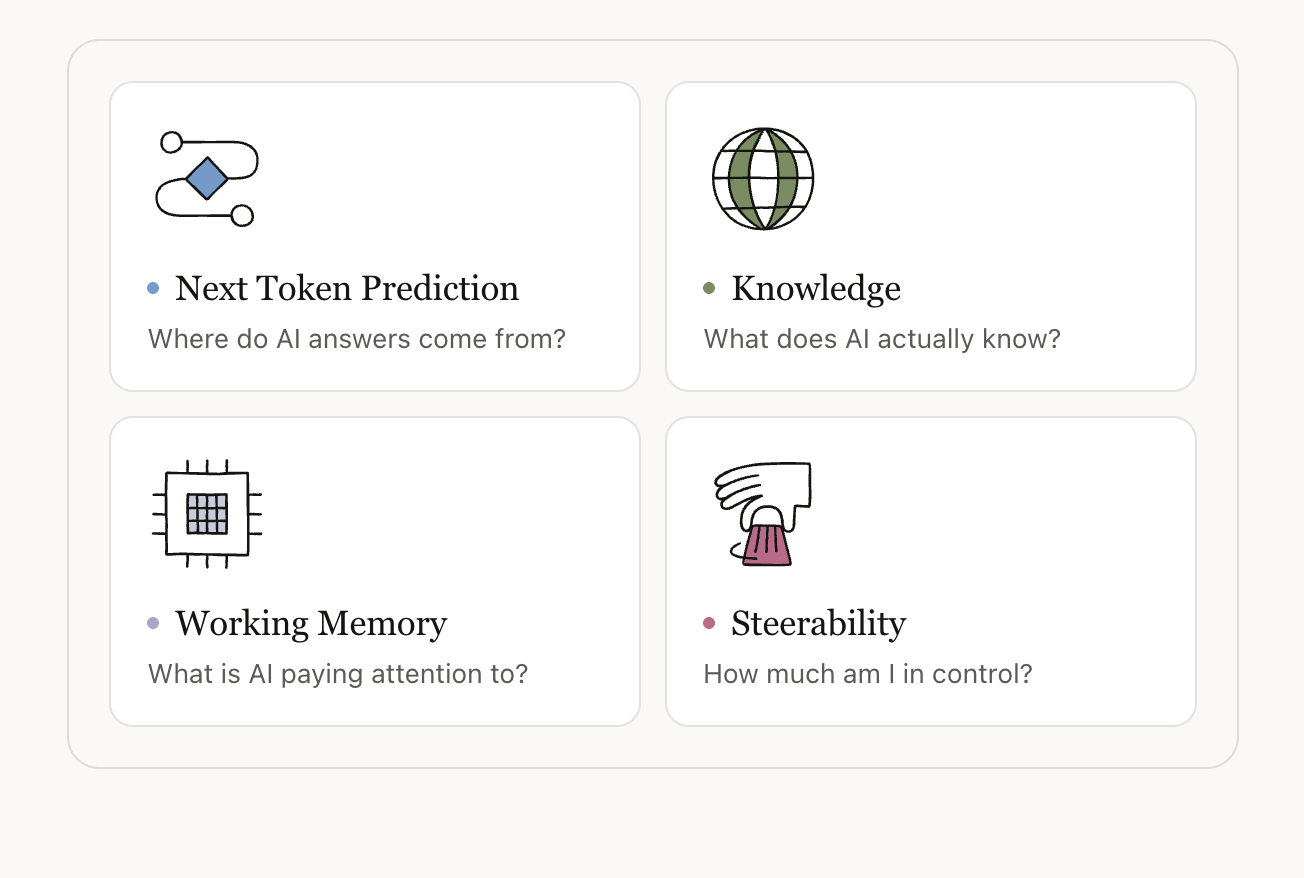
Next Token Prediction

Where do AI answers come from?

Generative AI writes answers word by word based on what tends to follow what. It is a vastly sophisticated autocomplete — not a search engine.

What this enables
  • Fluent, natural-sounding text in any style
  • Rapid synthesis across large amounts of material
  • Strong performance on tasks resembling its training data
Where it characteristically fails
  • Hallucination — plausible isn't the same as true
  • Confabulation concentrates in specifics: names, dates, citations, stats, URLs
  • Misplaced confidence — smooth prose wraps a guess
Claude features that push the edge out
Citations & source grounding Constrained generation Generator–verifier loops

Knowledge

What does AI actually know?

What the model knows comes entirely from its training data, frozen at a knowledge cutoff — what it read, and when it stopped reading.

What this enables
  • Extraordinarily broad general knowledge
  • Deep competence in well-represented domains
  • Unexpected connections across fields
Where it characteristically fails
  • Knowledge cutoff & staleness — true-then isn't true-now
  • Uneven coverage of niche, local, or recent topics
  • Source amnesia — "I read this somewhere" isn't a citation
Claude features that push the edge out
Web search Retrieval (RAG / connectors) Tool use for real-time data

Working memory

What is the AI paying attention to right now?

Everything the model is attending to lives inside a fixed-size context window. Context is leverage — until you hit the cliff.

What this enables
  • Rapid in-session adaptation to your docs, data, and constraints
  • Coherent work across long threads while space remains
  • Precise grounding in supplied material
Where it characteristically fails
  • Hard length limits — a cliff, not a gradient
  • "Lost in the middle" — buried details get less attention
  • No persistent memory by default; corrections don't carry over
Claude features that push the edge out
Memory Projects Context compaction File & artifact attachments

Steerability

How much am I in control?

The model follows instructions by continuing a pattern, not by understanding intent. Remarkably steerable — but a gap always exists between what you meant and what landed.

What this enables
  • Precise control over format, style, length, and tone
  • Role-setting and persona
  • Multi-step execution and iterative refinement
Where it characteristically fails
  • Reasoning drift — small errors compound over long chains
  • Letter-over-spirit — instruction honored, intent missed
  • Prompt injection — other text in context can steer it too
Claude features that push the edge out
System prompts / custom instructions Extended (visible) thinking Code execution

Go deeper

Anthropic Academy · Free course
AI Capabilities and Limitations Course
Work through each property with hands-on exercises, videos, and real examples in the full course. You'll learn to spot which property is in play when AI surprises you — and what to do about it.
Take the course
About 90 minutes