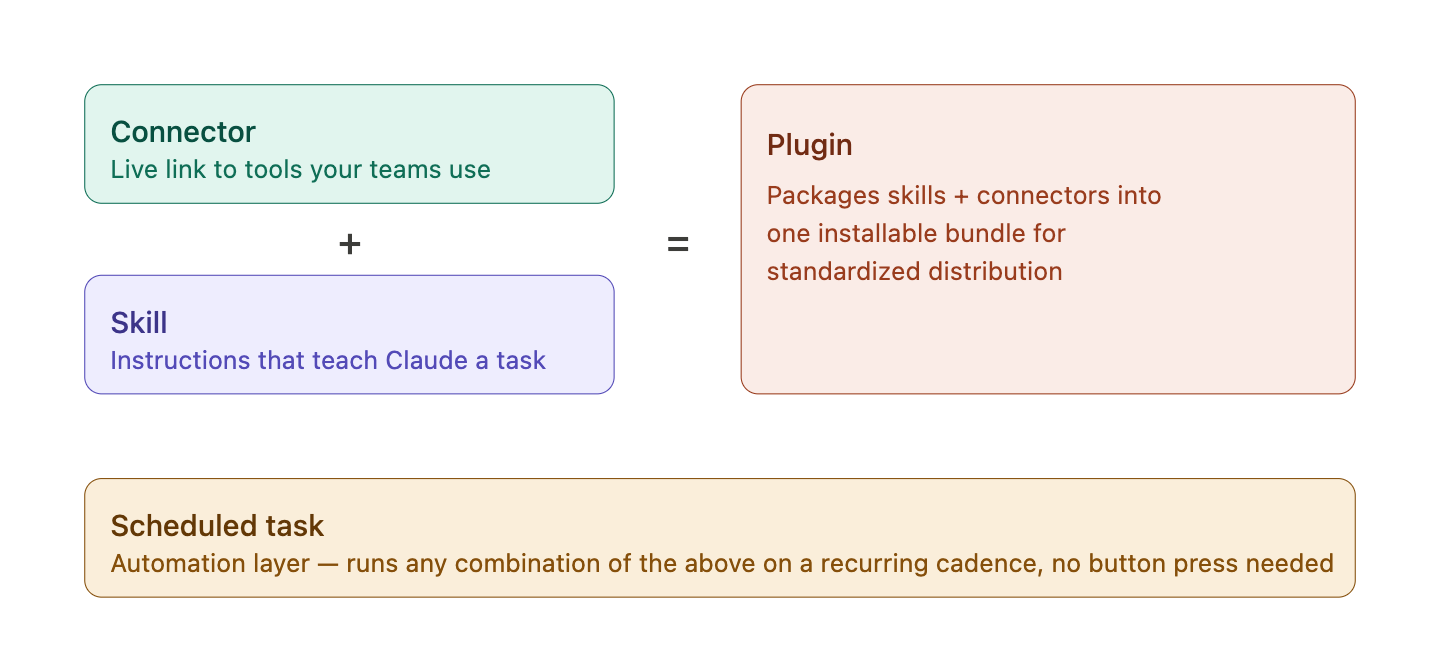
This guide serves as an operating-model for how skills, plugins, and connectors compose to transform work across departments. It answers the question you’ll face once Cowork is set up and you’re ready to roll it out to your teams: "we've deployed Cowork, now how do we think about building and governing the workflows that make it valuable?"
The organizations getting the most from AI aren't the ones with the best prompts — they're the ones that treat adoption as an organizational design problem.
Who this is for: Admins, AI CoE leaders, transformation teams and department leads — anyone responsible for making Claude Cowork work across the org. You won't build every workflow yourself — that happens through internal champions and power users who build for their teams. Your job is strategy, champion selection, and enablement.
Building blocks
Component
What it does
Help center
Connectors
Make your data accessible to Claude Cowork. Give Claude Cowork access to tools your teams use — Google Drive, Slack, Salesforce, GitHub, etc.
Here's how skills, connectors and plugins combine for a single finance workflow:
A finance team member asks Claude to reconcile the December cash account. The Finance plugin is installed, so Claude loads the reconciliation skill (step-by-step instructions for matching GL to bank). The data-warehouse connector retrieves the trial balance and transactions. Claude runs the comparison, flags discrepancies, and writes the workpaper back. One request, three pieces: connector feeds it data, skill directs Claude, plugin delivers it.
Skill flywheel: from individual to the organization
Skills, connectors and plugins scale beyond unique workflows for individuals. Taking finance as an example, here’s the typical flow for individual expertise to become an organizational capability:
Build: An FP&A manager may workshop and build a skill to pull monthly variance reports, including instructions on how to analyze revenue. The manager shares the skill with teammates.
Vet: They give it to a few FP&A analysts to test, screen and make sure the skill is effective and safe.
Promote: Once vetted, the finance champion promotes it to the Finance team plugin which ensures distribution to every finance teammate. Now, every FP&A analyst can run the variance skill on a scheduled cadence.
Spread: Throughout the department, the goal is to form a mature library of vetted skills: Accounting builds skills for completing journal entries, Treasury for completing daily cash management. They all get screened and approved by a department champion or admin.
Skills and plugins can drive horizontal workflows across your org, too. For example, an org-wide branding skill released by the design team could be provisioned by admins for every user of Cowork. Now when the Finance team creates charts, they always abide by the Org’s branding skill guidelines. Other workflows that cut across departments include Performance review skills that help managers draft self-reviews or compile peer feedback or a Company wiki built by connecting Claude Cowork to your knowledge base paired with skills that know how to search and synthesize it.
That’s the flywheel — personal expertise becoming organizational capability, and org capabilities and best-practices getting distributed across teams.
2. Choosing a governance posture
Workflows scale when skills get distributed through departments and surface to the rest of the organization. Governance posture is your stance on how freely that movement happens.
Your governance posture determines which of these paths are open. Think through the right skill and plugin management approach for your org as you select initial settings.
Posture
What it means
Org Settings > Skills Settings
Admin curated
Admins provision; users consume
Users can't create personal skills. Peer-to-peer and peer-to-org sharing are both disabled.
Skills and plugins come from admins only.
Skills: On User-created skills: Off Skill sharing: Off Share with organization: Off
Guided creation
Users create and share skills peer-to-peer; champions promote to plugins.
Users can create personal skills and share skills with peers.
Sharing disabled peer-to-org. Champions review and promote the best skills to team plugins.
Skills: On User-created skills: On Skill sharing: On Share with organization: Off
Fully open
Users create and share with each other and org-wide; admins monitor and curate plugins.
Users can create personal skills and share skills with peers and the org.
Admins monitor skill adoption and usage. Champions run quarterly skill reviews.
Skills: On User-created skills: On Skill sharing: On Share with organization: On
Posture isn't one switch — it's three org-level toggles in Settings → Skills, plus how you scope plugins:
User-created skills — can users build their own?
Skill sharing — can users hand a skill to a teammate?
Share with organization — can users publish to the org directory?
Plugin group access — which groups see / auto-install each plugin?
Plugin sharing to groups allows Admins to override a plugin's org-wide availability for specific groups, further scoping plugin access — e.g. make a plugin available only to the Legal group, or auto-install it for Engineering while keeping it hidden from everyone else.
Governance posture does not currently control Connector access. Connectors are org-wide on/off today and you can't scope them per team. RBAC only governs capability access (Cowork, Code, etc.), not skill sharing.
Champions are enthusiastic adopters who can help drive peer adoption across their teams. They will be participants in your pilot if you run one, and play a key role in your Cowork rollout. Champions are the people who will test workflows, demo at workshops, maintain plugins, and drive adoption within their departments.
Who makes a good champion:
A power user who is already getting value from AI tools - whether Claude or otherwise
Willing to build and experiment for their teams
Trusted by admins to help gather departmental feedback and surface blockers
How to find champions:
Usage analytics are a great signal for discovering champions. Anthropic provides per-user activity data which will help uncover power users early on.
Ask function leads to nominate
Target ratio 1 champion per 25–50 users
Mix technical and non-technical users across different departments
Include enthusiasts and sceptics; an all-enthusiastic pilot gives false positives
What to give champions:
Permission to create Skills and consider turning on peer-to-peer Skill sharing for pilot group
A 30-minute orientation on skills, plugins, and the governance model you're using
A channel (Slack channel, Teams group) where champions across departments can share what's working
Access to Anthropic's pre-built plugins as starting points
Recognition for their contributions to the rollout
What to expect from champions:
Build 2–3 starter skills for their team
Help their teams audit workflows and generate use case ideas
Run a skills workshop for their team
Own and maintain their department's plugins; identify the need for sub-team plugins (ex. Marketing vs. Demand Gen)
Surface what's working and what's not in the champions channel
Do a quarterly curation review of their department's skills
4. Rollout phases
The organizations that see the fastest, deepest value invest in readiness, curate first experiences, and govern deliberately by following these five principles.
Executive sponsorship: Visible and sustained — not just a kickoff email.
Curated first experiences: Guide users to high-value use cases, not blind experimentation.
Connectors enabled early: The aha moment arrives faster when Cowork reaches existing tools.
Champion network first: Every team needs someone who can demo, troubleshoot, and evangelize.
Governance defined upfront: Connector approval, skill creation, and access policies from Day 1.
Here's what a typical Cowork rollout looks like. Adapt the pace to your org. Note that the phases below assume Setup and Configuration steps from the Cowork Enterprise Admin Guide are complete.
Phase 1: Pilot
Goal: Validate your configuration and produce the first proof points with a small group of champions.
Admins and AI transformation teams own:
Recruit 1–2 champions per pilot department. Follow criteria in Section 3.
Enable initial connectors org-wide; sequence security review by risk tier (read-only first is common)
Set initial governance posture for the pilot group based on strategy for skill and plugin sharing across your org
Define 2–3 success metrics upfront and stand up feedback loops (pulse survey, dashboard review, escalation paths for feedback)
Announce launch, initial connectors and enablement opportunities to the pilot group
Champions own:
Install and try Anthropic's pre-built function plugins for their department
Build 2–3 starter skills for their own work
Report what's working / blocked in the champions channel
Exit when ready:
>70% weekly active users by week 4
Each pilot department has multiple repeatable use cases validated and documented
Champions are willing and briefed to run a workshop for their teams
What changes between pilot and broad rollout is usually the governance posture, new connectors cleared by security, and new departments onboarding with their own champions.
Phase 2: Expansion
Goal: Turn pilot proof points into department-level adoption — the skill flywheel starts here.
Admins and AI transformation teams own:
Open access to the next wave of departments; onboard their champions
Clear the next tier of connectors through security
Revisit governance posture with pilot evidence (most orgs loosen here)
Stand up self-service resources and a tiered support path (champion → program team → Anthropic)
Watch spend patterns and adjust controls
Champions own:
Run a skills workshop for their department (format → Section 5)
Surface team-built skills; promote the best into the department plugin
Share wins cross-department in the champions channel
Exit when:
Every onboarded department has a maintained plugin with a named owner
Workshop run in each department; majority of attendees built or adopted a skill
Connector and governance requests are flowing through a defined process
Phase 3: Scale and Monitor
Goal: Reach remaining departments and shift from launch mode to operating rhythm.
Stand up (or formalize) an AI Enablement CoE to own the skill library and advanced capabilities
Move measurement from activity (WAU, sessions) to outcomes (time saved, use-case ROI); report quarterly
Champions own:
Quarterly curation: surface the best skills from their teams, promote winners to plugins, archive stale skills, merge duplicates
Onboard replacement champions as people rotate
Building plugins and skills enablement into new-hire onboarding
You're in steady state when:
Every major department has an owned plugin and an active champion
New skills are entering the library faster from champions than from the program team
Quarterly ROI reporting is running based on business value, not just time-save
Pitfalls to avoid:
Launch ≠ enablement. IT flipping the switch and sending an email isn't a rollout.Treat a Cowork rollout as a program requiring change management.
First-impression failure. Unguided experimentation underwhelms — curate starter use cases per role and have champions lead first sessions.
The chat trap. Users default to short prompts with no connectors. Enablement must demo delegation side-by-side with chat. Push users to authenticate connectors when they get provisioned.
Treating config as permanent. Plan to revisit connectors and posture with usage evidence; a working proof point de-risks the next approval better than another security review.
Only measuring time-saved or login counts. Consider what ROI on Claude Cowork means for your business. Define outcome-based measures including net new work completed and qualitative feedback on use cases in addition to productivity measurement.
5. Enablement methods
Cowork training should be hands-on-keyboard when possible — the value shows up in doing, not watching. But "training" is really three different jobs depending on where a user is in their journey. Reference Anthropics researched-backed AI Fluency principles when designing enablement for your teams.
Enablement follows a natural progression: users start by completing a single task with a connector, then build competence with skills and plugins, then reach the point where Claude Cowork runs workflows for them automatically.
Phase 1: Activation (first prompt to first skill)
Get every user from zero to their first successful task with a connector.
Curated first session per role. Don't hand people a blank page. Share a one-pager or distribute a skill that describes "your first 3 tasks as a [sales rep / PM / analyst]."
Connector authentication moment. Users who never authenticate a connector get a chat experience, not a Claude Cowork experience. Don't leave this to chance: a 10-min calendar hold on launch day, or have a rotation of teammates available for setup assistance.
Side-by-side demo. The champion shows the same task done as a chat prompt vs. a delegated Claude Cowork task with connectors. Same input, different output.
1:many Cowork 101 training. Introduce skills, connectors, plugins and recurring tasks following the curriculum outlined in Intro to Claude Cowork
Phase 2: Enablement (connectors, skills, and real workflows)
Shift from first success to repeatable competence. Every user gets at least one skill they rely on and at least one plugin installed.
Skills workshop. The centerpiece of an enablement motion. A hands-on session where every attendee builds at least one skill for their actual work. Champions run one per department during Phases 2–3. See What are Skills?.
Plugin activation push. Users who install a plugin and run its skills early learn Claude Cowork faster. Ensure relevant plugins are available coming out of the Pilot, and include directions on how to use plugins in launch comms. See Managing Claude Cowork plugins.
Weekly office hours. 30-min drop-in where the champion screen-shares, unblocks stuck users, and demos new skills.
Skill of the week. Team posts one skill in the team channel with a short video of it running on real work. Skills provide inspiration for cross-functional teams.
Champion demo days. Cross-department show-and-tell on a monthly cadence. A sales champion demos their call-prep skill; an engineer demos their incident postmortem drafter. This is how ideas cross silos.
Phase 3: Habit (automation and steady state)
Lasting adoption means Claude Cowork is already running when users sit down in the morning.
Get everyone one scheduled task. Once a user has a daily pipeline digest or weekly report landing automatically, Claude Cowork comes to them. See Scheduled tasks.
Embed in existing rituals. The standard for a weekly pipeline review becomes the Claude Cowork-generated digest. The standard for a monthly board deck becomes a Claude Cowork-assembled first draft. Attach Claude Cowork to existing working rhythms.
Bake into new-hire onboarding. Include Cowork in Day-1 checklist: install the desktop app, authenticate 3 connectors, install the department plugin, run its flagship skill. See Installing Claude Desktop.
6. FAQ
Can I control which connectors specific users see? No. Currently, you can only enable connectors org-wide.
If I enable a connector, does Claude automatically access everyone's data? No. Connectors use a two-gate model: an admin enables the connector org-wide, then each user individually OAuths to link their own account. Claude can only access data within that user's existing permissions.
Can users share skills that include API keys or credentials? Skills should never contain credentials. If a skill needs authenticated access, it should use a connector. Include this in your champion training and skill-vetting process. We recommend creating a skill-audit skill that runs standard checks before approving skills for org-wide distribution or inclusion in plugins.
How do I prevent people from creating duplicate or low-quality skills? Namespace by department, run quarterly curation reviews, and use the champion model. The guided-creation posture is the best balance for most teams — people can create freely, but promotion to org level goes through a review.
How do plugins sync with version control? Plugins support GitHub sync. Connect a private GitHub repo as a plugin marketplace. Changes merge through your normal PR process and auto-sync to users. See Managing Cowork plugins for repo structure details.
What's the difference between a skill and a scheduled task? A skill runs when someone triggers it. A scheduled task runs a skill automatically on a cadence — daily, weekly, etc. Common use: a daily pipeline digest that runs every morning at 8am and posts to Slack.
Where do I go for help with desktop app installation or connector setup? See the Claude Cowork Enterprise Admin Guide, which covers desktop app deployment, connector configuration, and org architecture setup.