Advancing your firm’s AI maturity
Chapter 01Two investment firms can equip the same number of people with access to Claude and see different results. What an analyst gets from Claude depends on what the firm has built around it: which systems Claude can read and write, how much of the work it is trusted to finish, and whether the team’s best methods are written down where everyone can run them. In the deployments we see, impact grows with the complexity of the work Claude can do, and that complexity grows with the access and trust the firm has extended to Claude. The maturity model below makes the progression visible: where your firm stands today, and what it needs to do to get to the next level.
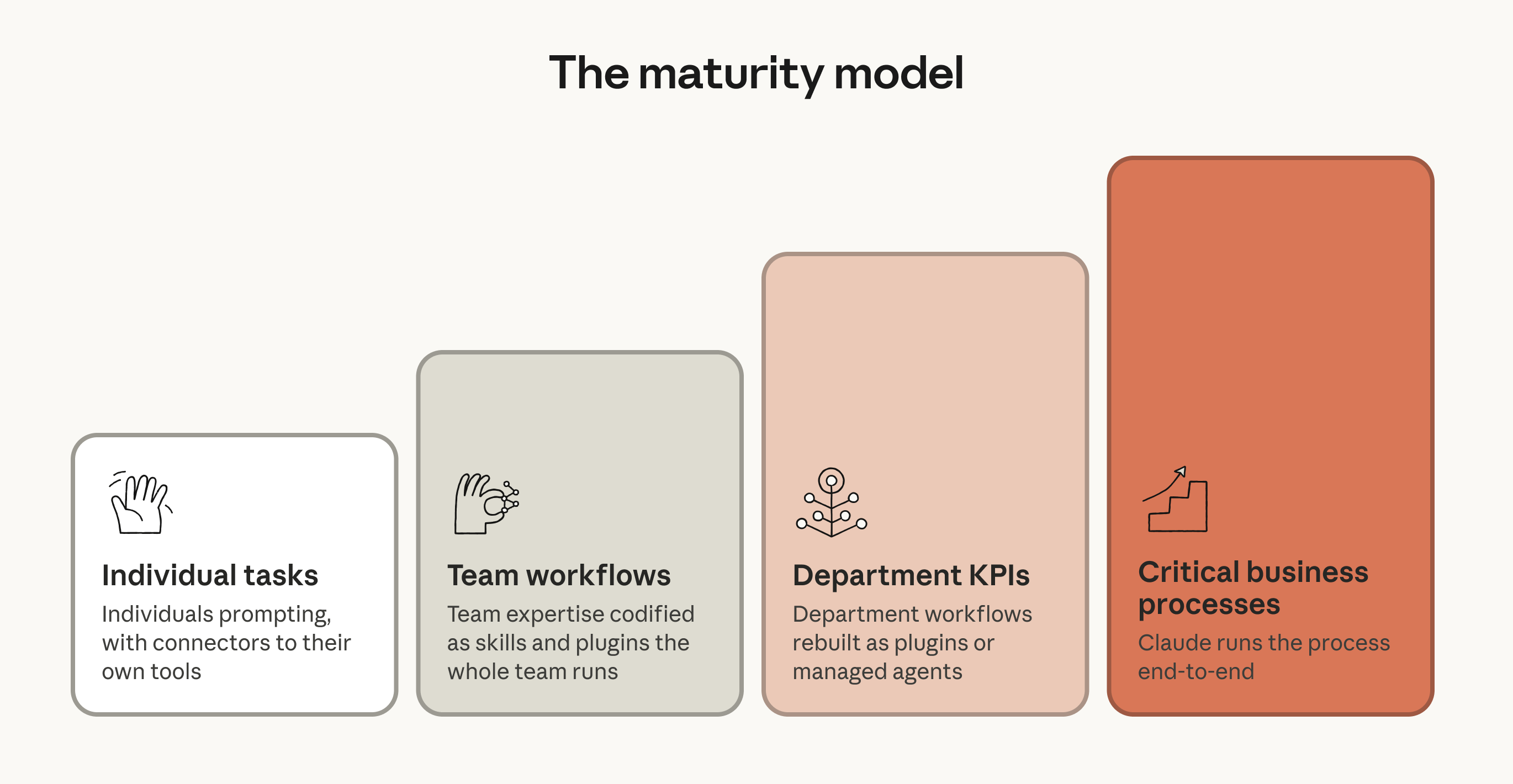
Individual tasks. People prompt Claude on single tasks, with connectors to their own tools. To move up, senior people write the team’s methods down as skills.
Team workflows. The team’s expertise is written as skills and plugins that everyone runs. To move up, the firm connects Claude to the team’s systems, records baselines, and builds evals from the team’s real work.
Department KPIs. Departments rebuild workflows as plugins or managed agents tied to a KPI, and Claude does the work while a person checks it. To move up, the evals show the agent meets the owner’s standard, and governance covers who publishes skills, what data each workflow reaches, and who owns the results.
Core business processes. Claude runs the process, and a person reviews the exceptions and approves the results before they're acted on.
Firms hand work to Claude in stages. Once the evals indicate that the agent’s work has met the standard set by the owner, each process moves to the next stage. In every example we outline in this guide, the assumption is that a person reviews and approves the work before it goes to a client, gets filed, or is acted on.
Most firms start by giving employees a chat assistant, which they can use for drafting emails or doing research. The firms that move up the ladder connect Claude to the systems their teams use and trust it with more complex work. Employees build fluency, from using Claude on single tasks to running several workflows in parallel. At the higher levels, departments rebuild workflows as plugins or managed agents tied to a KPI. The end state is Claude running a process end to end, with a person checking the exceptions and a sample of the rest.
Firms need to establish governance that supports who can publish skills, what data each workflow can reach, and who owns the results. This investment continues throughout the life of the program.