Tasks that demand both deep domain knowledge and quantitative rigor play directly to Opus 4.6's strengths. Upload your SEC filings, trial protocols, and patent filings. Opus 4.6 reads the full set before surfacing findings, reasons through the dependencies across documents, and flags details you have forgotten to ask. The buried regulatory requirement in the example could materially change the risk profile relative to management's guidance, and it wasn't something you prompted for.
The prompt below gives Opus 4.6 a broad mandate rather than prescribing every step. It sets the investment question, points to the documents, and then asks Claude to find the contradictions and tell you what you should be worried about.
I'm evaluating Meridian Therapeutics (~$4B mid-cap biotech) ahead of their Phase III readout. I've uploaded the 10-K, 10-Q, proxy, trial protocol, and patent filings.
Evaluate the science and trial design. Build a risk-adjusted pipeline valuation. Flag anything in the filings that contradicts management's guidance or earnings narrative. Model the downside scenarios I should be stress-testing.
Produce a research memo and a downloadable model. Tell me what I should be worried about that I haven't asked about.
Give Claude the full stack. Opus 4.6 reads everything before surfacing findings, so what it catches depends on what's in context. A risk factor buried in the 10-K can only contradict a revenue assumption in the 10-Q if both are uploaded together.
If your filings are already on your computer, Cowork in Claude Desktop [research preview] can read them directly from a folder rather than uploading individually.
Claude can also search the web or use Claude in Chrome [beta] to find additional context beyond your uploads.
Extended Thinking lets Claude scale how deeply it reasons based on task complexity. For multi-document financial analysis, it's worth turning on.
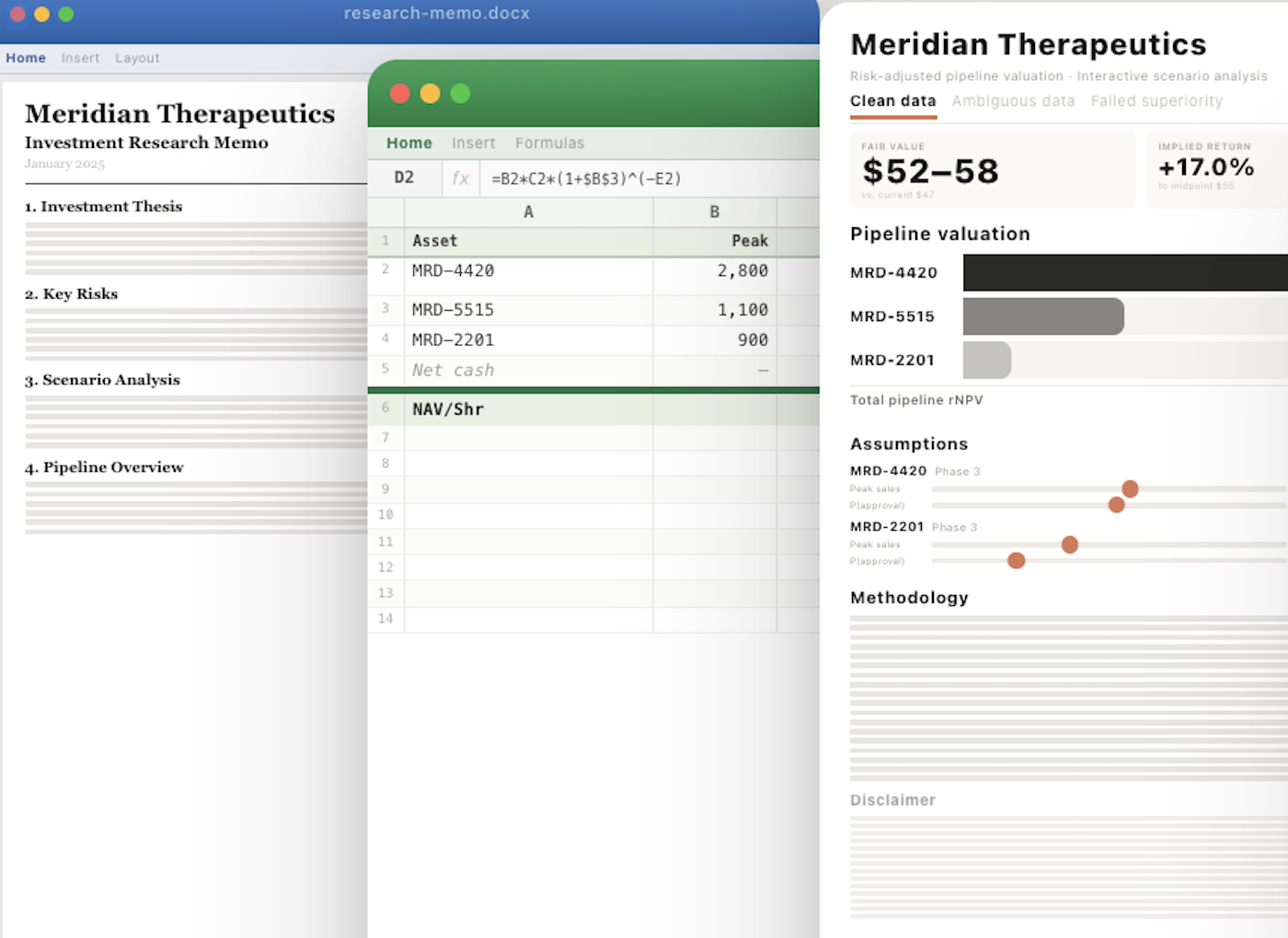
Claude produces an integrated research memo, a downloadable financial model, an interactive scenario dashboard, and a patent cliff timeline. Opus 4.6 reads across all five documents simultaneously, and one finding it surfaced on its own is the kind of detail that could change the risk assessment.
1. Mechanism and Phase II signal
MRD-4420 is a selective JAK1 inhibitor targeting the IL-6/STAT3 axis in rheumatoid arthritis. The selectivity matters — first-generation JAK inhibitors hit multiple isoforms, triggering the 2021 FDA boxed warning. Phase II showed ACR50 response rates of 48% vs. 32% for adalimumab (n=340), clinically meaningful but not powered for cardiovascular safety.
2. Phase III risk
The superiority design (n=1200) requires wider margins than non-inferiority. At the Phase II effect size, power is ~88%. If the effect attenuates 25% (common in Phase II-to-III transitions), power drops to ~62%.
3. Buried regulatory finding
Page 187 of the 10-K discloses an FDA request for a 52-week cardiovascular safety assessment — not in the original protocol. Cross-referencing the 10-Q, R&D guidance increased $45M without explanation. This likely means an additional safety extension study: 12–18 months added to timeline, $40–50M in costs, pushing earliest revenue to late 2028 vs. management’s mid-2027 guidance. At $68M quarterly burn, cash runway narrows from 14 months post-filing to roughly 8.
4. Scenario summary
The model maps three scenarios based on the assumptions above:
Clean data, on-timeline: highest valuation range. Ambiguous data with 6-month delay and dilutive raise: mid-range. Failed superiority with pivot to non-inferiority: lowest range.
Per-share estimates depend on your discount rate, probability weights, and dilution assumptions. Adjust these in the downloadable model below.
[View the scenario dashboard]
Toggle between scenarios and adjust key variables (probability of success, peak sales, discount rate, timeline delay) and watch the valuation recalculate in real time.
[View the timeline]
Core composition-of-matter patent expiration in 2036, method-of-use extension to 2039, mapped against cash runway and projected revenue ramp under each scenario.
[Download: meridian-therapeutics-pipeline-model.xlsx]
Adjustable inputs for all key variables. Changing any assumption recalculates pipeline NPV and dilution scenarios automatically.
Important: Claude is a research tool, not a financial advisor. This analysis surfaces findings and structures scenarios based on the documents and assumptions you provide. All projections reflect those inputs and may not match actual outcomes. Consult a qualified financial professional before making investment decisions.
Opus 4.6 is the strongest model at surfacing answers from dense document sets. With Research, Opus 4.6 goes off on its own, pulls from dozens of sources across competitor pipelines, FDA advisory committee meetings, analyst reports, and more, then comes back with a full, structured report ready for review.
Research the competitive landscape for JAK inhibitors in autoimmune. Who else is in Phase II or III with selective JAK1 programs? How does MRD-4420’s selectivity compare, and is there a risk a competitor reaches market first?
Opus 4.6 holds both the science and the financials in context at once, which means it can reason through multi-step problems where a change in one domain cascades into another.
Model what happens if Phase III misses the superiority endpoint by a narrow margin. Walk through the decision tree: does management pivot to non-inferiority? How does that cascade through the timeline, cash runway, and valuation?
Opus 4.6 produces financial models and scenario analyses structured for direct use. Export to Claude in Excel to stress-test assumptions interactively and integrate with your own models.
Export the pipeline valuation model to Excel. I want to adjust the discount rates and approval probabilities myself and run additional sensitivity analysis.
Opus 4.6 reads across your full document set before surfacing findings. The quality of what you share upfront directly shapes the quality of what you get back. Upload the complete filing set at once. The cross-document connections are where the critical findings live.
If your team runs due diligence with a standard set of steps, checklists, or evaluation criteria, you can package that process as a Cowork plugin. A plugin teaches Claude your specific methodology — what to look for in filings, how to weight risk factors, which red flags to escalate — so the analysis follows your framework, not a generic one. You could set up a /due-diligence command that runs your full process against any new set of filings, or a skill that applies your firm’s valuation standards automatically whenever Claude builds a model.
Opus 4.6 works through more of the analysis before asking for direction, and it reads across documents in ways that catch what a surface read won’t. An instruction like “flag anything that changes the investment thesis” often surfaces findings you didn’t know to look for.