What are the key benefits of transitioning to agentic coding for software development?
Agentic coding transforms how developers work—instead of suggesting code snippets, AI agents like Claude Code execute entire tasks autonomously. Discover the key benefits driving this shift and how to get started using Claude Code.
The shift from AI-assisted to agentic coding represents a fundamental change in how you work with code. Traditional AI tools complete syntax and answer documentation questions, while agentic systems execute entire development tasks autonomously—navigating codebases, understanding dependencies, modifying multiple files, and verifying their changes work correctly.
Think of the difference this way: autocomplete reduces keystrokes and chat assistants explain concepts, but agentic systems actually implement features. When you describe a requirement like "add pagination to the user listing API," an agent doesn't just suggest code snippets. It finds the relevant endpoint, analyzes the current implementation, adds pagination logic following your project's patterns, updates related tests, and ensures the changes integrate properly with your existing database queries.
This autonomous execution spans your entire development workflow. Agents handle the implementation details while you focus on architecture, user experience, and business logic. The technology has matured from experimental concept to production-ready systems that you can rely on daily.
Dramatic acceleration of development timelines
The speed gains from agentic coding extend far beyond typing assistance.
Augment Code, which uses Claude on Google Cloud's Vertex AI, documented one enterprise customer completing a project in two weeks that their CTO estimated would require four to eight months with traditional development.
Tasks that would take weeks for a developer to learn can now be completed in a day or two.
– Chief Scientist Guy Gur-Ari, Augment Code
This acceleration stems from eliminating cognitive overhead in complex codebases. Modern applications contain millions of interdependent lines spread across hundreds of files. Before making any change, you spend hours tracing function calls, understanding data flow, and mapping dependencies. A simple feature addition might touch dozens of files: the API endpoint, data models, validation logic, database queries, frontend components, and tests.
Agentic systems navigate this complexity for you. They trace how a user action flows from the frontend through API layers to database queries and back, identify every location where a data structure change needs propagation, and understand which tests need updating when an API contract changes. What takes you hours of investigation, agents complete in minutes.
The compound effect transforms project economics. Tasks that seemed too expensive become feasible. Technical debt that would take months to address gets resolved incrementally. You can iterate faster, experiment more, and respond to user feedback immediately rather than planning sprints around implementation capacity.
Exponential improvement in developer onboarding
Developer onboarding traditionally consumes weeks or months as you build mental models of complex systems. If you're a senior developer, you lose productive time explaining architectural decisions, walking through code organization, and reviewing pull requests that miss important context. Documentation becomes outdated as systems evolve.
When you use agentic coding, your onboarding drops from weeks to one or two days. When you're new to a codebase, you ask agents to explain system architecture, trace feature implementations, or clarify design patterns. The agent serves as a thinking partner with perfect recall of the entire codebase, available instantly without interrupting senior team members.
This changes team dynamics fundamentally. You can tackle tasks previously reserved for senior engineers because agents bridge knowledge gaps in real-time. When you need to modify the authentication system, you don't need months of context—you describe the requirement to the agent, which handles the implementation while explaining what it's doing.
Your team can confidently assign work across broader areas of the codebase. The traditional bottleneck where only a few senior engineers understand critical systems disappears, and you gain the context and capability to contribute meaningfully from day one.
Autonomous problem-solving across complex systems
Traditional development automation requires predetermined scripts where every step is mapped in advance. These scripts break when assumptions change. Agentic systems work differently. They assess tasks dynamically, choose appropriate tools based on context, evaluate results, and adjust strategies when initial approaches fail.
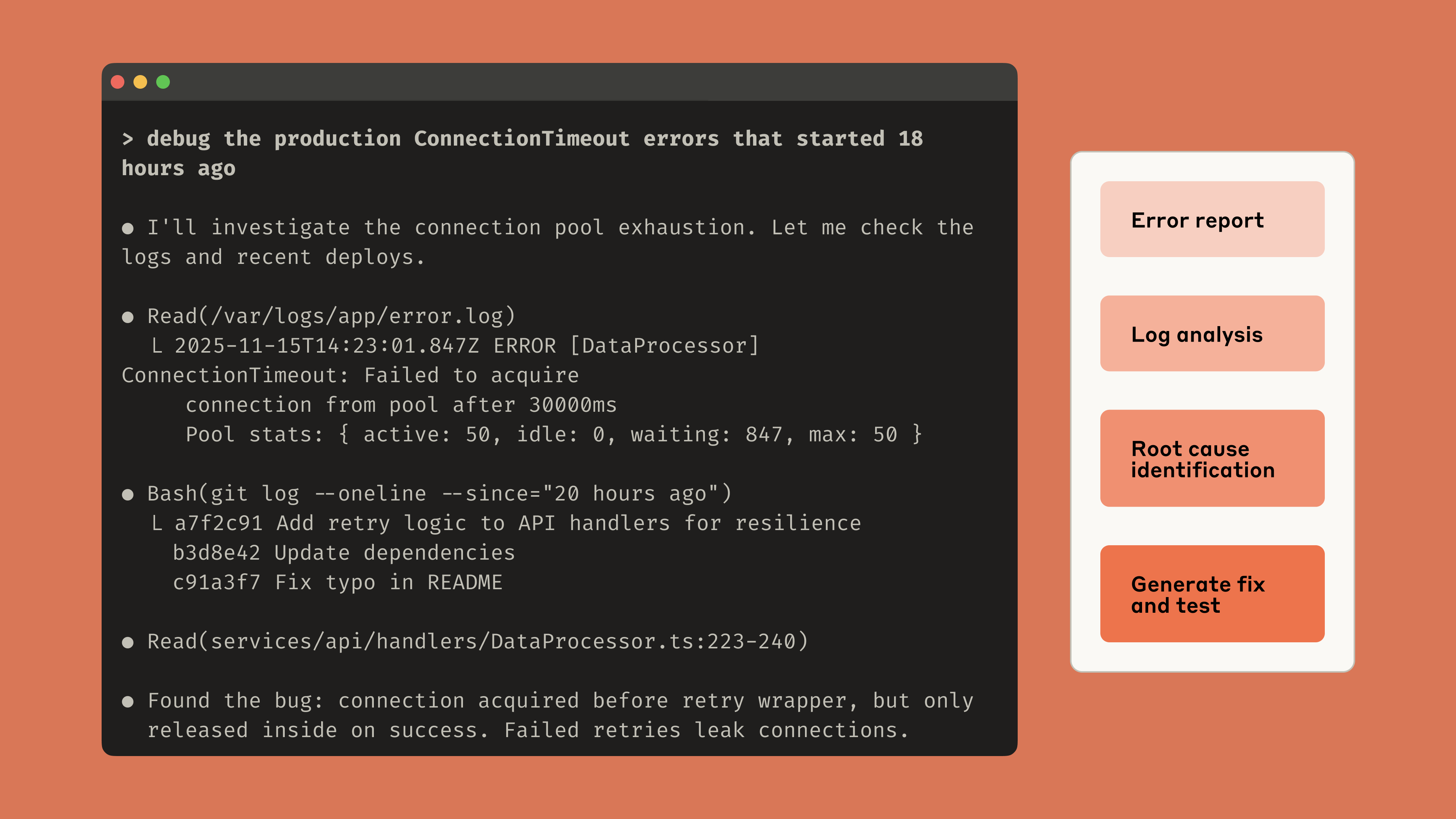
Claude Code identifying a production bug
Consider debugging a production issue. An agentic system like Claude Code analyzes the error report, searches relevant log files, traces the issue across multiple services, and identifies the root cause in a shared library. It then generates a fix that doesn't break dependent systems, creates comprehensive test coverage for the edge case, and prepares a pull request with detailed documentation. If the first hypothesis proves wrong, it pivots to alternative explanations rather than stopping.
Claude Code specifically excels at multi-file operations that traditionally require deep system knowledge. It reads your entire project structure, understands build configurations, recognizes framework conventions, and maintains consistency across changes. When you're refactoring a data model that impacts dozens of components, Claude Code ensures every reference updates correctly, all type definitions align, and database migrations handle edge cases properly.
This resilience lets you tackle problems where the solution path isn't obvious. Complex refactoring, performance optimization, and security audits—tasks that typically require senior expertise—can be delegated to agents while you review and guide the approach.
Scaling development without linear headcount growth
The most strategic benefit emerges at the organizational level: breaking the linear relationship between system complexity and team size.
As software grows more complex, traditional approaches demand proportional increases in engineering headcount. Each new feature requires more people to understand and maintain expanding codebases. Communication overhead increases while coordination becomes harder and quality suffers.
Agentic systems change this equation. A single agent simultaneously works across multiple areas of a large codebase with perfect context retention. Agents don't experience communication overhead that limits team scaling, don't require management hierarchy, and work continuously without context switching or fatigue.
This multiplies your effectiveness rather than replacing you. Your team of ten engineers supported by agentic systems tackles workloads that traditionally require twenty or thirty. You complete more projects simultaneously, maintain velocity on legacy systems while building new products, and compete effectively against larger competitors despite smaller teams.
Enhanced code quality through systematic analysis
Code quality often degrades under deadline pressure. You might take shortcuts, miss edge cases, or skip documentation. Code review depends on reviewer expertise and available time. Agentic systems approach quality systematically, analyzing every change against established patterns and best practices.
They identify potential issues you might overlook: race conditions in concurrent code, memory leaks in long-running processes, security vulnerabilities in input handling, and N+1 query patterns that degrade database performance. They ensure consistent code style across your team, implement security best practices automatically, and document code comprehensively as they write.
Claude Code refactoring a file, adding in relevant comments to track changes
Claude Code particularly shines at maintaining consistency across large changes. When refactoring a data model that touches dozens of files, it ensures every reference updates correctly, all type definitions align, database migrations handle edge cases, and tests cover the new structure. This systematic approach catches subtle issues that might escape initial review but cause production problems later.
When you implement agentic coding, you'll see fewer production incidents, reduced technical debt accumulation, faster debugging when issues occur, and more maintainable codebases. The agents serve as quality gatekeepers, ensuring standards are met consistently regardless of deadline pressure or your individual experience level.
Democratized access to complex development capabilities
Agentic coding makes sophisticated development accessible to you regardless of your specialization. Tasks requiring deep expertise become achievable when working with Claude as your thinking partner. This democratization has immediate practical impact.
Grafana's implementation demonstrates this clearly. Their Claude-powered intelligent assistant enables you to extract insights from observability data through natural language. You ask questions like "What's causing latency spikes in the checkout service?" and Claude automatically identifies relevant metrics, constructs appropriate PromQL and LogQL queries, correlates data across systems, and presents actionable insights. Previously, only if you had specialized query language expertise could you perform such analysis.
This pattern extends across domains. You can optimize database queries even if you're primarily a frontend developer, improve UI performance even if you're a backend specialist, and tackle infrastructure automation even if you're junior. The barrier to contributing across the full stack drops significantly.
For your organization, this means hiring strategies change. Instead of searching for rare combinations of expertise, your team can hire people with strong fundamentals and let agents bridge specialized knowledge gaps. Your team can confidently tackle diverse projects without needing specialist developers for every technology stack.
Making the transition with Claude Code
When you're ready to adopt agentic coding, Claude Code offers the most comprehensive solution for developers. Unlike web-based chatbots which analyze code snippets you paste in a browser, Claude Code operates directly in your terminal or IDE with full access to read and modify your codebase.
Installation takes just minutes and works in your terminal or IDE.
"L'intelligenza di Claude Sonnet 4.5 si nota subito: sfrutta meglio il contesto del codebase di Augment, gestisce attività su orizzonti più lunghi e apre nuove possibilità agentiche che stiamo esplorando attivamente."
Once installed, navigate to your project directory and run claude to start a session. Claude Code analyzes your project structure, identifies your framework and language patterns, and prepares to work with your specific development environment. You maintain full control: Claude Code asks for your approval before making any file changes.
Start with smaller tasks to build confidence: ask Claude Code to add error handling to an API endpoint, refactor a complex component, or write tests for uncovered code. As you experience its capabilities firsthand, you'll naturally expand to more complex operations like cross-cutting refactors and architectural improvements.
FAQ
Gli strumenti tradizionali di programmazione basati sull'IA suggeriscono singole funzioni o frammenti di codice in base al contesto immediato. Tu ti occupi dell'integrazione, del test e di assicurarti che il codice rispetti le convenzioni del progetto.
Gli strumenti di programmazione agentica comprendono l'intero progetto, pianificano gli approcci di implementazione ed eseguono flussi di lavoro completi in modo autonomo. Forniscono funzionalità testate e integrate che seguono i tuoi pattern consolidati.
Gli strumenti di programmazione agentica come Claude Code possono operare per periodi prolungati mantenendo il contesto e creando basandosi sul lavoro precedente. La sessione di refactoring autonomo di Rakuten, della durata di sette ore, dimostra un lavoro tecnico prolungato senza intervento umano. La durata dipende dalla complessità del compito e dai requisiti del progetto.
Claude Code si integra con i tuoi flussi di lavoro di sviluppo esistenti integrandosi con il terminale. Puoi incorporarlo gradualmente nelle pratiche attuali, iniziando con attività specifiche come il test o la documentazione, prima di passare allo sviluppo completo di funzionalità.
Articoli correlati
Accedi alle altre novità sui prodotti e scopri le best practice per i team che programmano con Claude.
Jun 18, 2026
Steering Claude Code: CLAUDE.md files, skills, hooks, rules, subagents and more