Lovable turns a plain-language description of an app into production-grade software. Users shape it through a back-and-forth conversation, refining until it matches what they had in mind. Since its launch in November 2024, people have built more than 50 million projects on Lovable.
With Claude, Lovable:
- Reached $200 million in annualized recurring revenue 12 months after launch, now at $400m ARR
- Powers more than 50 million projects built on the platform, over 200,000 per day
- Serves non-technical founders, teams of all sizes, and large enterprises including Microsoft, Uber, HubSpot, and Zendesk
The challenge

A capable model for building software
Before Lovable, Anton Osika, Lovable’s CEO and co-founder, says he kept having the same conversation. “There’s been so many people coming to me saying, ‘I’d love to build something. I have a great idea that I want to turn into reality, but I can’t code,’” he said.
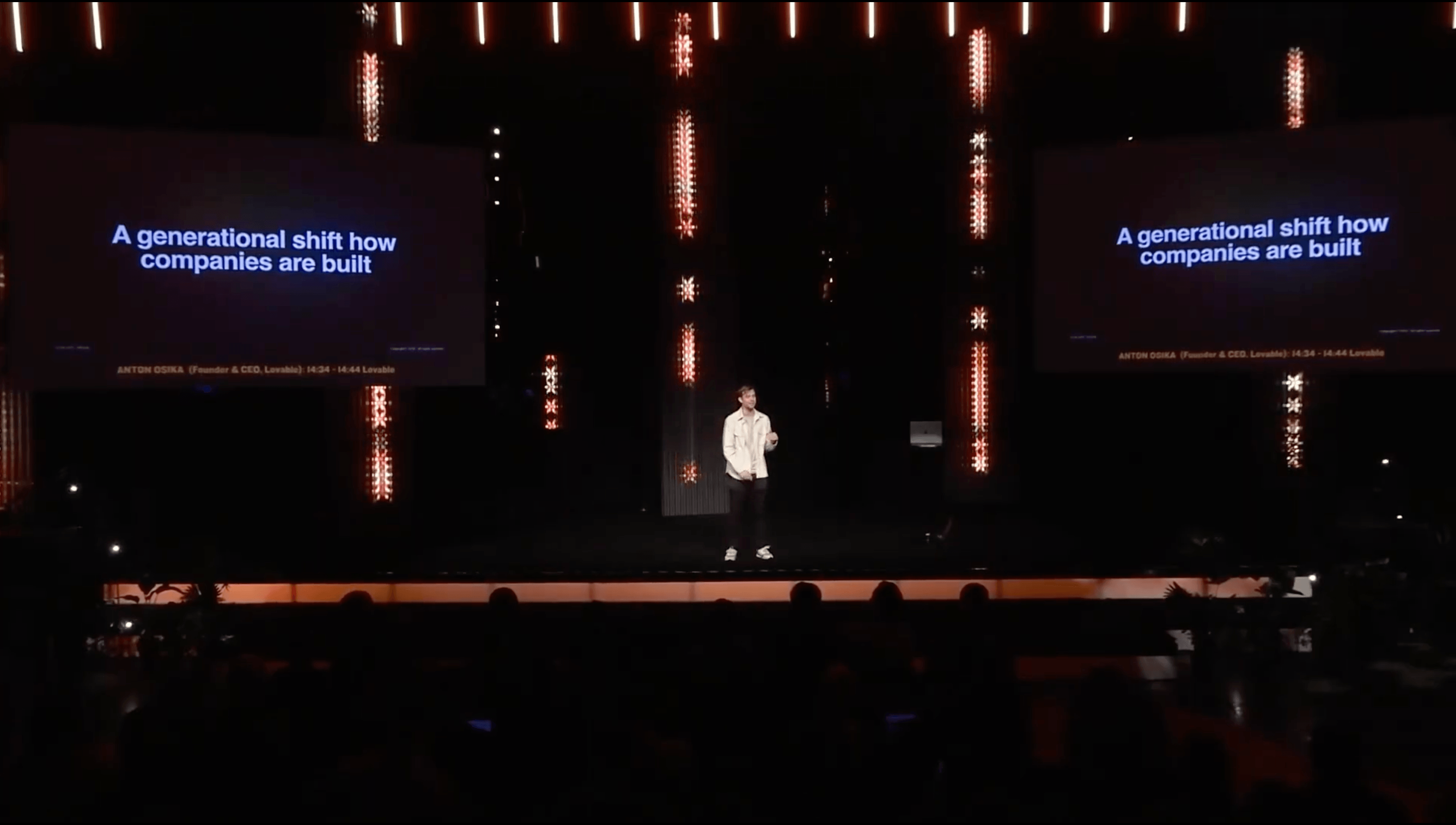
In early 2023, he built a weekend side project to help developers move faster with AI and posted it to GitHub as an open-source experiment. It went viral, but the people showing up to use it weren’t the developers he had built it for. A few days later, he woke up certain. “I realized the world is not going into a future where just us engineers look at code to build software,” he said. “It’s going to be a completely new type of interface.” That morning and his co-founder Fabian Hedin mapped out what would soon become Lovable.
Anton says he pictured far more people building software and running whole businesses on it: founders, teams driving change inside companies and government, and domain experts who knew exactly what their work needed. The team needed a capable model at the core of its product.

The most driven founders are problem solvers. Watch their unscripted conversations with the Anthropic engineers.
Read moreThe solution
A thought partner, not a code generator
Anton is precise about what Lovable is. “We’re not in the business of code generation,” he says. “We’re in the business of unlocking new economies and empowering every human out there who wants to create something. We take something that’s super complex, and we try to make it seem very, very simple.”
That planning capability is core to the experience. Lovable’s first version took instructions and carried them out. Then came chat-based planning, where people work through what to build and how to structure it before any code is written. As that layer matured, the product began to feel like a partner. “We start seeing Lovable more as a co-founder than an AI software engineer,” Osika said. It decides how to act on the user’s behalf, sometimes working quickly and sometimes taking longer, then telling the user it’s done and asking what to change.
Alexandre Pesant, who leads product at Lovable, has watched that capability deepen with each model. “We’ve followed each model update because each model is better than the previous one,” he said. “Claude has a strong combination of great coding abilities and conversational abilities.”
Under the surface, Lovable runs on an agentic architecture. “We have a harness around a main agent that can use subagents to orchestrate tasks effectively, with the right models at each step,” said Pesant. The main agent reasons about a build and hands smaller pieces of work to subagents, matching each task to the model best suited to it.
Specific Claude releases marked turning points in what users could build. “Claude Sonnet 3.5 was the first model that made agents work,” said Pesant. “Claude Opus 4.5 was the next big step change in reliability on long-horizon tasks, unlocking a new class of projects.”
Every new Claude release goes through the same evaluation Lovable has run from the start, measuring how often the system hits a wall and produces an app that’s broken or isn’t what the user asked for. That gate matters because Lovable’s users often can’t read the code themselves, so they’re trusting the output to work. For Osika, earning that trust is the harder, more durable goal. “Something that I think is very, very rare in AI is a trusted brand that people love and keep coming back to,” he said. “To have that trusted brand, that’s not something that you magically achieve.”

Learn when to use Haiku, Sonnet, or Opus to get better results and stay inside your rate limit. A practical guide to picking the right Claude model.
“We’re in the business of unlocking new economies and empowering every human out there who wants to create something.”
The outcome

From idea to $200 million in a year
Within a year of launch, Lovable reached $200 million in annualized recurring revenue. More than 50 million projects have been built on the platform, over 200,000 a day, and the apps people build there draw more than 600 million visits a month.
What those numbers represent matters to Osika as much as their size. “Fundamentally, I think software should be about human emotions and the way to create products that really delight,” he said, which is where the company’s name comes from.
That belief shows in what people build. The people closest to a problem can now create the software to solve it. Alan, a non-technical founder, set out to fix healthcare staffing and built an AI-powered staffing platform on Lovable in five months that was generating a million dollars in revenue. A team in Portugal stood up a coordination platform to respond quickly to multiple weather emergencies. Doctors Without Borders staff working in the Amazon jungle run scheduling and inventory on software they built and adjust themselves as they use it. Large enterprises build on Lovable too, among them Uber, HubSpot, and Zendesk.
Osika expects that to widen as the friction keeps falling. “There is fundamentally more human agency that’s unlocked when frictions for starting a company and building your product start disappearing,” he said. “We’re entering an era where there are more societal problems that are getting solved. We’re seeing that live with millions of people building on top of our platform.”
“Claude Opus 4.5 was the next big step change in reliability on long-horizon tasks, unlocking a new class of projects.”
Ähnliche Beiträge

Wie Notion Agenten mit Claude Managed Agents bereitstellt und skaliert

Produkt- und Marketing-Führungskräfte von HubSpot über die Skalierung von Claude Cowork

Wie Slack, ein Salesforce-Unternehmen, mit Claude Unternehmenswissen erschließt
