Opus 4.6 および Sonnet 4.6 における 1M コンテキストの一般提供を開始
どちらのモデルでも、1M のウィンドウ全体に標準料金が適用され、ロングコンテキストの割増料金はかかりません。メディアの制限も拡大され、最大 600 枚の画像または PDF ページを扱えるようになります。
Claude Platform において、Claude Opus 4.6 と Claude Sonnet 4.6 で、最大 100 万(1M)トークンのコンテキストウィンドウをすべて基本料金のまま利用できるようになりました。標準価格はウィンドウ全体に適用されます。100 万トークンあたり Opus 4.6 では $5/$25、Sonnet 4.6 では $3/$15 です。 単価が割増しされることはなく、90 万トークンを送信するリクエストでも、9,000 トークンの場合と全く同じトークン単価で計算されます。
一般提供開始に伴う変更点:
- 均一料金でコンテキスト ウィンドウ全体が利用可能。ロングコンテキストの割増料金はありません。
- すべてのコンテキスト長でフルレート制限を適用。標準アカウントのスループットがウィンドウ全体に適用されます。
- 1 回のリクエストあたり 6 倍のメディアに対応。これまでの 100 から、最大 600 枚の画像または PDF ページに拡大されました。本日より Claude Platform の標準機能として利用できるほか、Microsoft Foundry および Google Cloud の Vertex AI でも利用可能です。
- ベータヘッダーが不要に。20万トークンを超えるリクエストも自動的に処理されます。 すでにベータ版ヘッダーを送信している場合でも無視されるため、コードを変更する必要はありません。
Opus 4.6 を利用する Max、Team、Enterprise のユーザー向けに、Claude Code で 1M コンテキストが利用できるようになりました。Opus 4.6 のセッションでは 1M のコンテキストウィンドウ全体を自動的に使用できます。これにより、圧縮の頻度が減り、会話のより多くの部分がそのまま保持されます。これまで、1M コンテキストの利用には追加の使用枠が必要でした。
長大なコンテキストでも精度を維持
100 万トークンという膨大なコンテキストも、モデルが必要な情報を正確に引き出し、全体を踏まえて推論できなければ意味がありません。Opus 4.6 は MRCR v2 ベンチマークで 78.3% を記録し、同等のコンテキスト長を扱うフロンティアモデルの中で最高のスコアを達成しました。
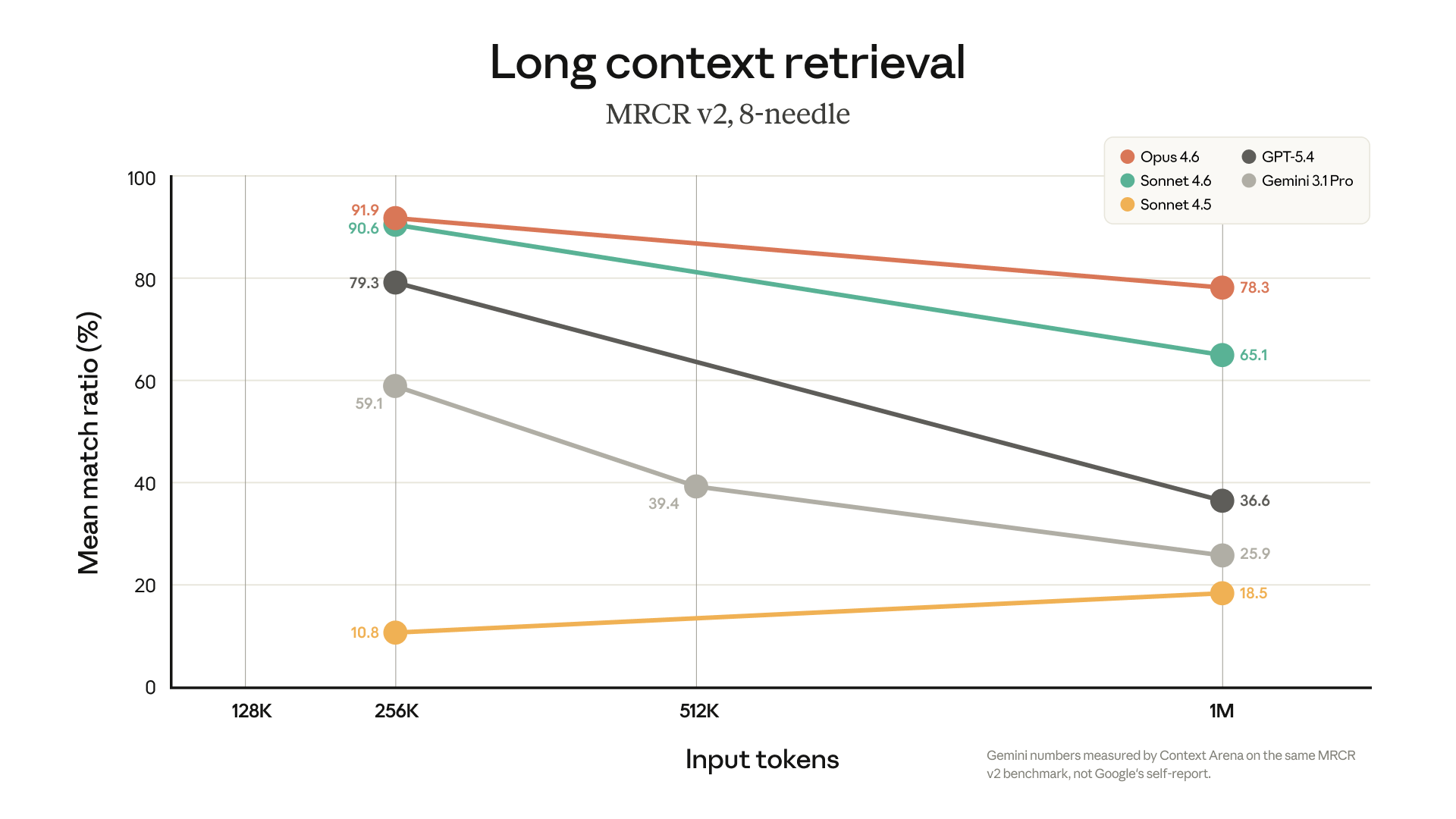
これにより、コードベース全体、数千ページに及ぶ契約書、または長期間稼働するエージェントの完全なトレース(ツールの呼び出し、観察、中間の推論過程など)を読み込み、直接利用することができます。以前はロングコンテキストの処理に必要だったエンジニアリング作業、情報の欠落を伴う要約、コンテキストのクリアはもう必要ありません。会話全体がそのまま保持されます。

“Claude Code can burn 100K+ tokens searching Datadog, Braintrust, databases, and source code. Then compaction kicks in. Details vanish. You're debugging in circles. With 1M context, I search, re-search, aggregate edge cases, and propose fixes — all in one window.”

“Before Opus 4.6's 1M context window, we had to compact context as soon as users loaded large PDFs, datasets, or images — losing fidelity on exactly the work that mattered most. We've seen a 15% decrease in compaction events. Now our agents hold it all and run for hours without forgetting what they read on page one.”

“Opus 4.6 with 1M context window made our Devin Review agent significantly more effective. Large diffs didn't fit in a 200K context window so the agent had to chunk context, leading to more passes and loss of cross-file dependencies. With 1M context, we feed the full diff and get higher-quality reviews out of a simpler, more token-efficient harness.”

“Eve defaults to 1M context because plaintiff attorneys' hardest problems demand it. Whether it's cross-referencing a 400-page deposition transcript or surfacing key connections across an entire case file, the expanded context window lets us deliver materially higher-quality answers than before.”

“Scientific discovery requires reasoning across research literature, mathematical frameworks, databases, and simulation code simultaneously. Claude Opus 4.6’s 1M context and expanded media limits let our agentic systems synthesize hundreds of papers, proofs, and codebases in a single pass, helping us dramatically accelerate fundamental and applied physics research.”

“With Claude's 1M context, an in-house lawyer can bring five turns of a 100-page partnership agreement into one session and finally see the full arc of a negotiation. No more toggling between versions or losing track of what changed three rounds ago.”

“Large-scale production systems have endless context, and production incidents can get very complex. With Claude's 1M context window, we are able to keep every entity, signal, and working theory in view from first alert to remediation without having to repeatedly compact or compromise the nuances of these systems.”

“We raised our Opus context window from 200k to 500k and the agent runs more efficiently — it actually uses fewer tokens overall. Less overhead, more focus on the goal at hand.”

“Real-world spreadsheet tasks require deep research and complex multi-step plans. Claude's 1M context window let’s us maintain task adherence and attention to detail.”