Kontextfenster mit 1 Mio. Tokens ist jetzt für Opus 4.6 und Sonnet 4.6 allgemein verfügbar
Ab sofort gelten für beide Modelle die Standardpreise für das gesamte 1 Mio. Token-Fenster, ohne Aufpreis für Abfragen mit langem Kontext. Das Medienlimit wird auf 600 Bilder oder PDF-Seiten erweitert.
Für Claude Opus 4.6 und Sonnet 4.6 gelten jetzt Standardpreise für das gesamte 1 Mio. Token-Kontextfenster auf der Claude Platform. Die Standardpreise gelten für das gesamte Fenster – USD 5/USD 25 pro Million Tokens für Opus 4.6 und USD 3/USD 15 für Sonnet 4.6. Es gibt keinen Multiplikator: Eine Anfrage von 900.000 Token wird mit derselben Gebühr pro Token abgerechnet wie eine Anfrage von 9.000.
Was bei allgemeiner Verfügbarkeit neu ist:
- Ein Preis für das gesamte Kontextfenster. Kein Aufpreis für Anfragen mit langem Kontext.
- Volle Ratenlimits für jede Kontextlänge. Ihr Standarddurchsatz pro Account gilt für das gesamte Fenster.
- 6-mal mehr Medien pro Anfrage. Bis zu 600 Bilder oder PDF-Seiten, gegenüber 100. Ab heute nativ auf der Claude Platform, Microsoft Foundry und Vertex AI von Google Cloud verfügbar.
- Kein Beta-Header erforderlich. Anfragen mit mehr als 200.000 Tokens funktionieren automatisch. Wenn Sie bereits den Beta-Header verwenden, wird er ignoriert. Es sind keine Codeänderungen erforderlich.
Für Nutzer von Max, Team und Enterprise ist jetzt in Claude Code mit Opus 4.6 ein Kontextfenster mit 1 Mio. Tokens enthalten Opus 4.6-Sitzungen können das gesamte 1 Mio. Tokens-Kontextfenster automatisch nutzen, sodass weniger Komprimierungen erforderlich sind und mehr von der Konversation erhalten bleibt. Bisher waren für Kontext mit 1 Million Tokens zusätzliche Nutzungskontingente erforderlich.
Viel Kontext, der nicht verloren geht
Kontext mit einer Million Tokens ist nur dann sinnvoll, wenn das Modell die richtigen Details abrufen und übergreifend verarbeiten kann. Opus 4.6 erzielt 78,3 % bei MRCR v2, der höchste Wert unter den Frontier-Modellen bei dieser Kontextlänge.
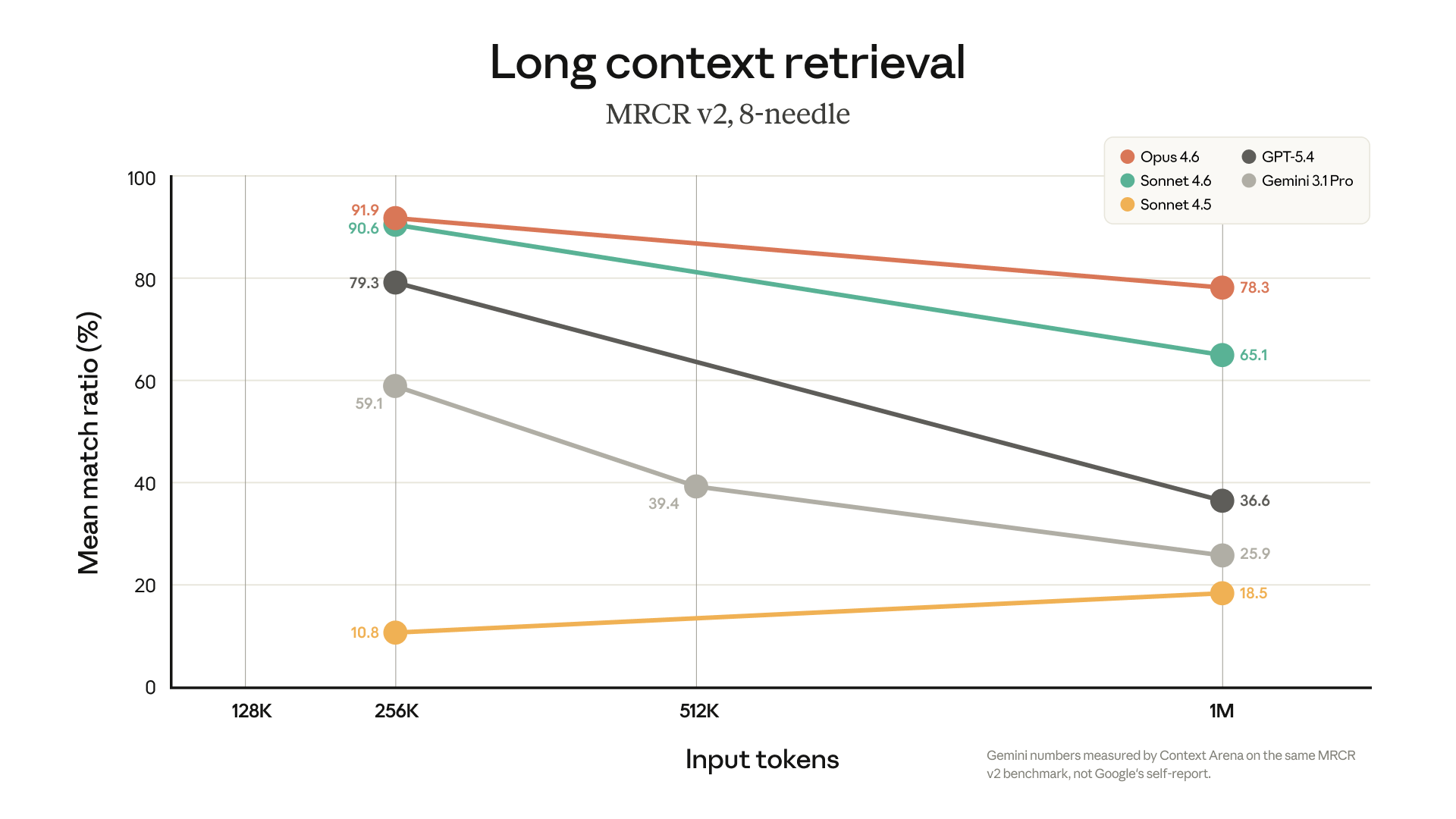
Das bedeutet, dass Sie eine gesamte Codebasis, Tausende von Seiten mit Verträgen oder die vollständige Ablaufverfolgung eines lang laufenden Agenten – Toolaufrufe, Beobachtungen, Zwischenergebnisse – laden und direkt verwenden können. Die Engineering-Arbeiten, die verlustbehaftete Zusammenfassung und die Kontextbereinigung, die bei der Arbeit mit langen Kontexten bisher erforderlich waren, fallen jetzt weg. Das gesamte Gespräch bleibt erhalten.

“Claude Code can burn 100K+ tokens searching Datadog, Braintrust, databases, and source code. Then compaction kicks in. Details vanish. You're debugging in circles. With 1M context, I search, re-search, aggregate edge cases, and propose fixes — all in one window.”

“Before Opus 4.6's 1M context window, we had to compact context as soon as users loaded large PDFs, datasets, or images — losing fidelity on exactly the work that mattered most. We've seen a 15% decrease in compaction events. Now our agents hold it all and run for hours without forgetting what they read on page one.”

“Opus 4.6 with 1M context window made our Devin Review agent significantly more effective. Large diffs didn't fit in a 200K context window so the agent had to chunk context, leading to more passes and loss of cross-file dependencies. With 1M context, we feed the full diff and get higher-quality reviews out of a simpler, more token-efficient harness.”

“Eve defaults to 1M context because plaintiff attorneys' hardest problems demand it. Whether it's cross-referencing a 400-page deposition transcript or surfacing key connections across an entire case file, the expanded context window lets us deliver materially higher-quality answers than before.”

“Scientific discovery requires reasoning across research literature, mathematical frameworks, databases, and simulation code simultaneously. Claude Opus 4.6’s 1M context and expanded media limits let our agentic systems synthesize hundreds of papers, proofs, and codebases in a single pass, helping us dramatically accelerate fundamental and applied physics research.”

“With Claude's 1M context, an in-house lawyer can bring five turns of a 100-page partnership agreement into one session and finally see the full arc of a negotiation. No more toggling between versions or losing track of what changed three rounds ago.”

“Large-scale production systems have endless context, and production incidents can get very complex. With Claude's 1M context window, we are able to keep every entity, signal, and working theory in view from first alert to remediation without having to repeatedly compact or compromise the nuances of these systems.”

“We raised our Opus context window from 200k to 500k and the agent runs more efficiently — it actually uses fewer tokens overall. Less overhead, more focus on the goal at hand.”

“Real-world spreadsheet tasks require deep research and complex multi-step plans. Claude's 1M context window let’s us maintain task adherence and attention to detail.”
Erste Schritte
Kontext mit 1 Mio. Tokens ist heute nativ auf der Claude Platform und über Amazon Bedrock, Vertex AI von Google Cloud und Microsoft Foundry verfügbar. Nutzer von Claude Code Max, Team und Enterprise auf Opus 4.6 erhalten standardmäßig Zugriff auf das Kontextfenster mit 1 Mio. Tokens.
Weitere Informationen dazu finden Sie in unserer Dokumentation und in der Preisübersicht.