
Prompt
Copy the prompt and paste it into a new session in Claude Science. By default, Claude asks with a permission card before it runs code or installs packages.Prompt
Documentation Index
Fetch the complete documentation index at: /docs/llms.txt
Use this file to discover all available pages before exploring further.
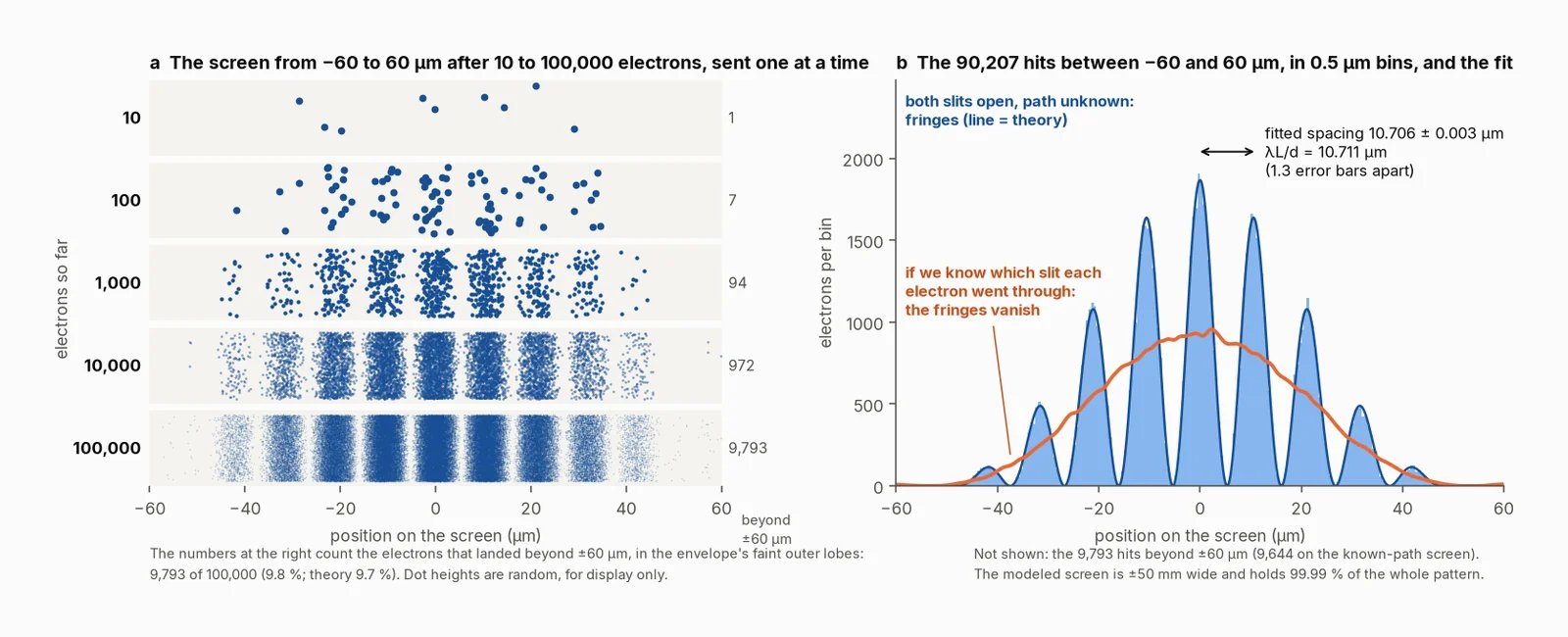
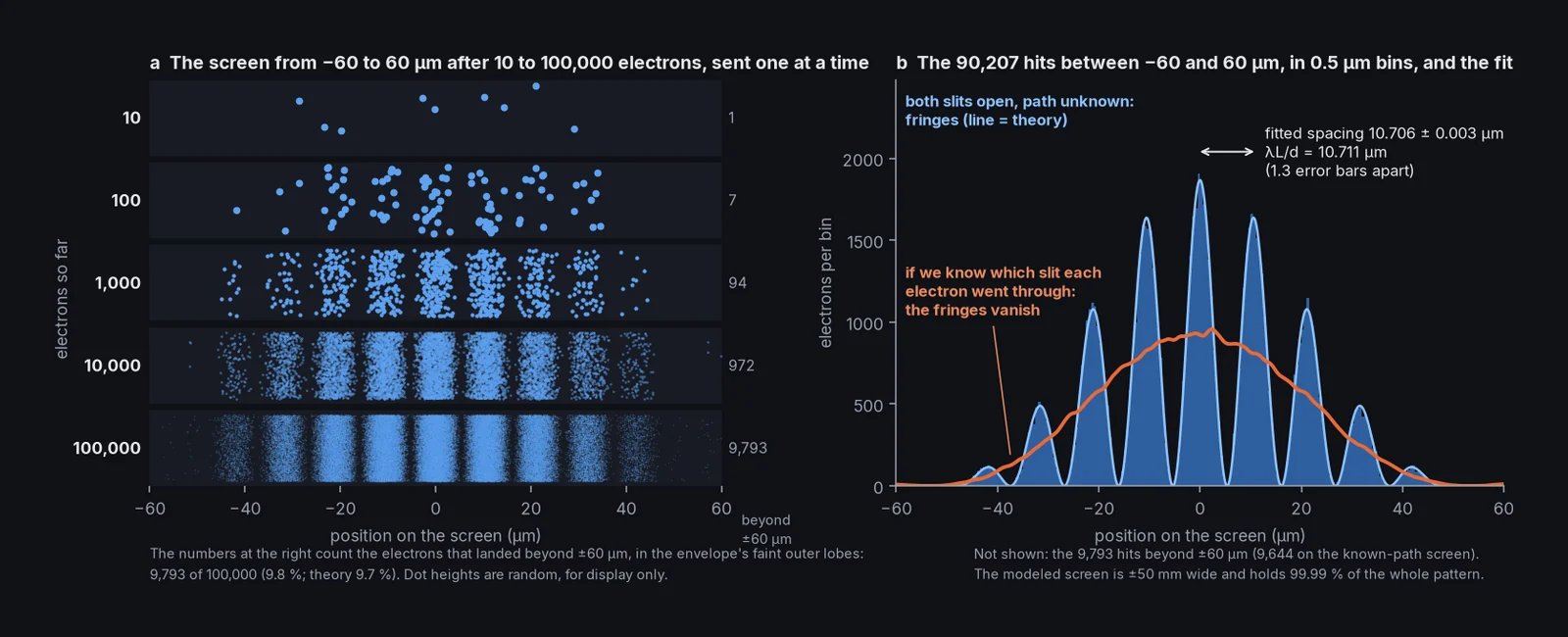
Rebuild the picture of Tonomura’s 1989 experiment with an ideal double slit: each electron lands as 1 random dot, yet fringes 10.7 µm apart build up.


In 1989 Akira Tonomura's team at Hitachi sent electrons one at a time past an electron biprism, the electron version of a double slit, and filmed an interference pattern building up dot by dot. Recreate that with an ideal double slit. Say nothing else about the 1989 experiment.
Take electrons accelerated through 50 kV (work out their de Broglie wavelength, with relativity), 2 slits 0.1 µm wide and 0.5 µm apart, and a screen 1 m away (check that d²/λL ≈ 0.05, so the simple far-field formula holds). Compute the probability of landing at each position on the screen. Then draw random hits from it, one electron at a time, and show the screen from −60 to 60 µm after 10, 100, 1,000, 10,000 and 100,000 electrons, noting on the figure how many hits land outside.
Fit the final pattern to measure the fringe spacing, and give it with its error bar: how many error bars from λL/d? Then show that the fringes vanish if we know which slit each electron went through. Explain each step as you would to an undergraduate.
Was this page helpful?