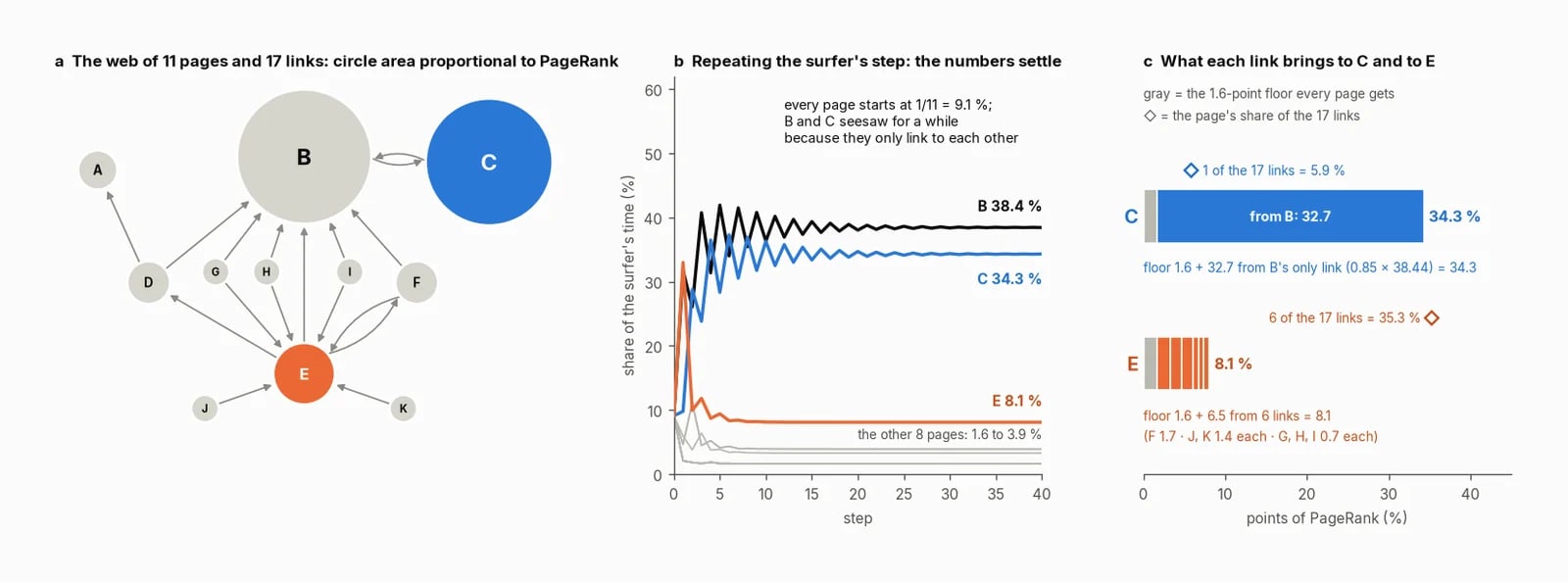
PageRank is the idea that launched Google (Brin & Page, 1998): a page matters if pages that matter link to it. Here is a tiny web of 11 pages, A to K, where B→C means that page B links to page C:

B→C, C→B, D→A, D→B, E→B, E→D, E→F, F→B, F→E, G→B, G→E, H→B, H→E, I→B, I→E, J→E, K→E

Imagine a surfer who follows a random link on the current page 85 % of the time and jumps to a random page the rest of the time. From a page with no links, the surfer always jumps to a random page. Start with the surfer equally likely to be on any page, and repeat that step until the share of time spent on each page stops changing. That share is the page's PageRank.

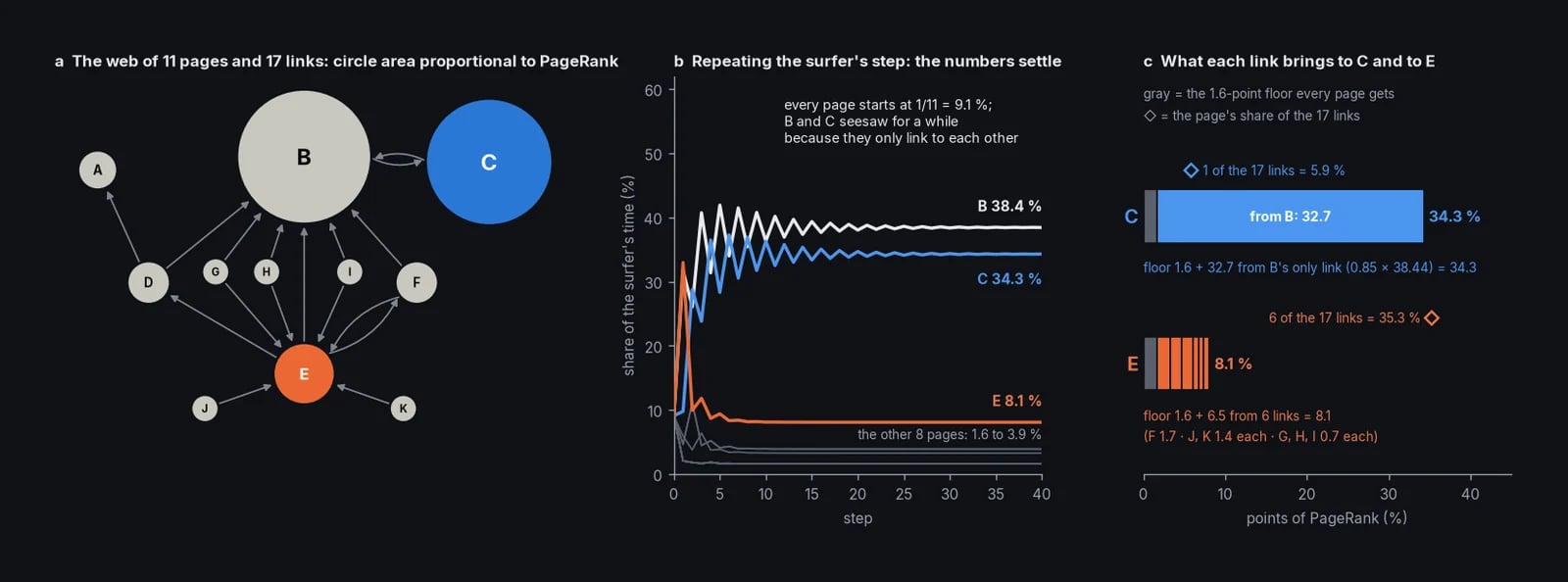
Draw the web as circles with area proportional to PageRank, each letter inside its circle, C and E in color, no other labels, and plot how the 11 numbers settle. This is the example drawn in Wikipedia's PageRank article; its values are B 38.4 %, C 34.3 %, E 8.1 %, D and F 3.9 %, A 3.3 %, G to K 1.6 %. Then compare each page's PageRank with its share of the 17 links. C has 1 incoming link, but it is B's only link, and ranks 2nd; E has 6, all from low-ranked pages, and gets 8.1 %. Show how many points each link brings to C and to E. Explain each step as you would to an undergraduate.