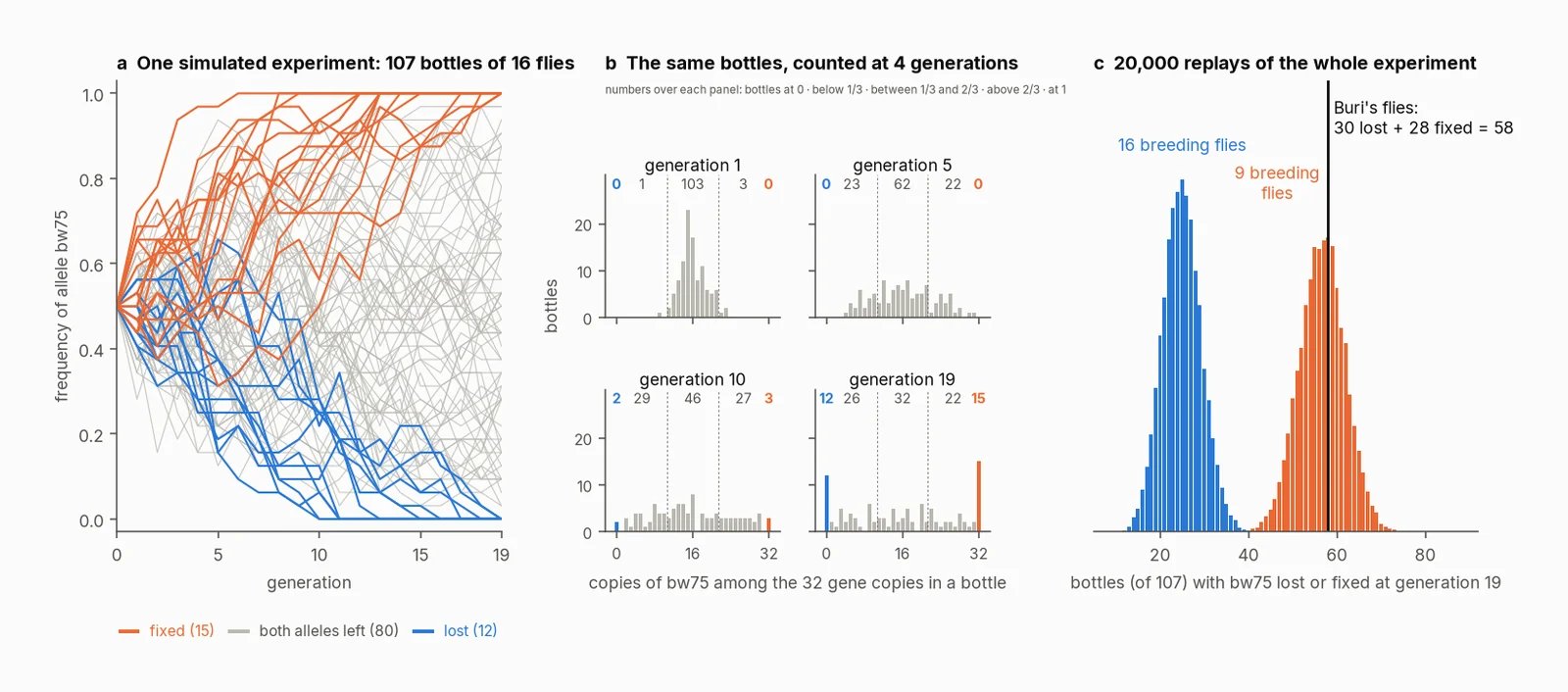
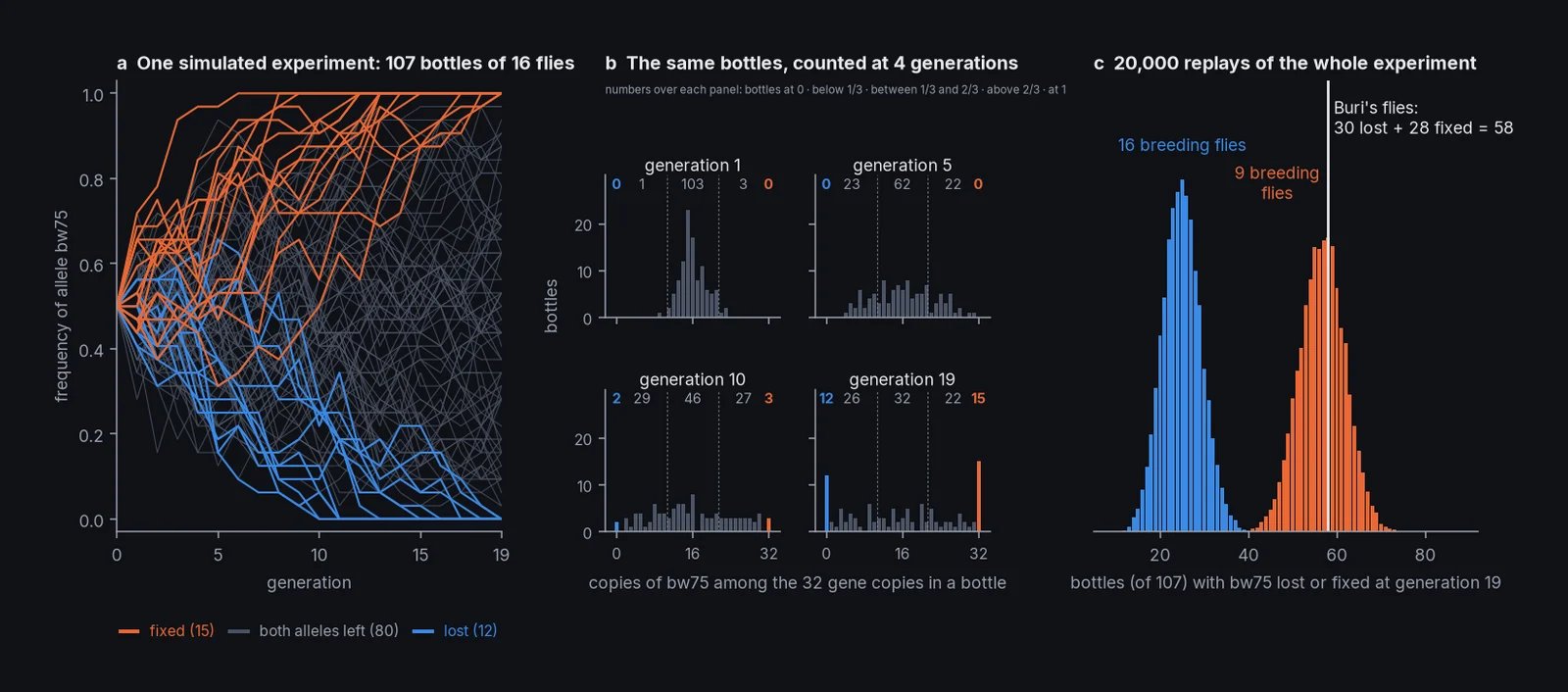
In a 1956 paper, Peter Buri described keeping 107 bottles of fruit flies for 19 generations, restarting each bottle every generation with 8 males and 8 females picked at random. Every founder carried one copy each of two neutral eye-color alleles, bw and bw75, so bw75 started at a frequency of 0.5 in every bottle.

Simulate this with random sampling only: no selection, no mutation. Plot the bw75 frequency in all 107 populations over time, and draw histograms of the 107 frequencies at generations 1, 5, 10 and 19. Under each, print how many bottles are at 0, below 1/3, between 1/3 and 2/3, above 2/3, and at 1, and describe the change using only these 5 counts.

By generation 19, Buri found bw75 lost in 30 bottles and fixed in 28. Repeat your simulated experiment 1,000 times: how often does chance alone give that many? What population size would match his result? Compare it with Buri's own estimate for these bottles, about 9 breeding flies (2Ne = 17.86). Buri wrote that the causes are not known, but that unequal numbers of offspring per fly, down to sterility, are certainly part of it. This simulation does not test that, so report it as his view, in 1 or 2 sentences, and add no other causes. Explain each step as you would to an undergraduate.