
Prompt
Copy the prompt and paste it into a new session in Claude Science. By default, Claude asks with a permission card before it runs code or installs packages.Prompt
Documentation Index
Fetch the complete documentation index at: /docs/llms.txt
Use this file to discover all available pages before exploring further.
Split a 300 mm steel ruler clamped at one end into 4 beam elements and check its bending under 1 N and its first 3 vibration modes against beam theory.


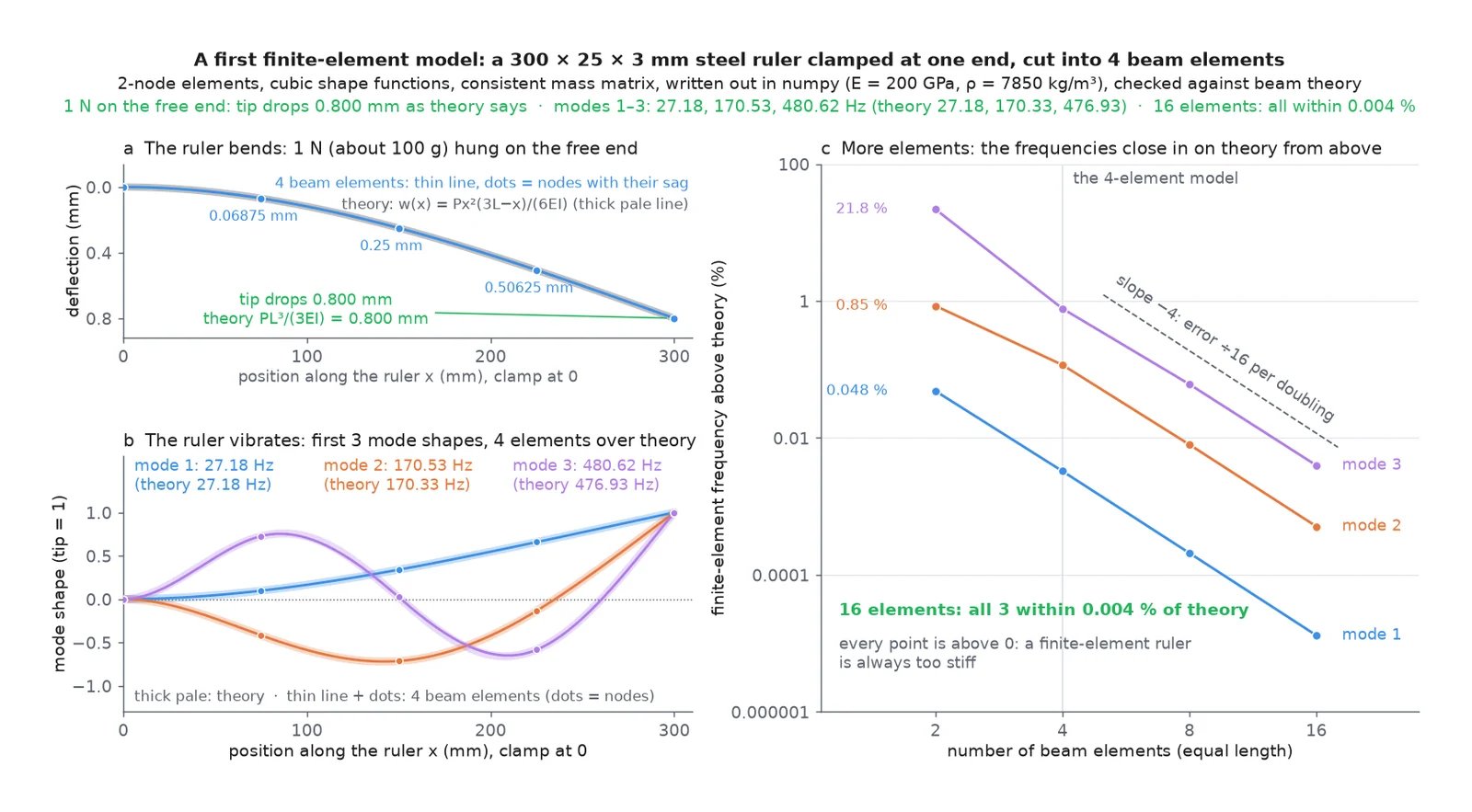
I'm learning the finite-element method. Model a steel ruler clamped at one end: length 300 mm, width 25 mm, thickness 3 mm, E = 200 GPa, density 7850 kg/m³. Split it into 4 standard 2-node beam elements (cubic shape functions, consistent mass matrix) and write the matrices yourself with numpy. First hang 1 N (about 100 g) on the free end: beam theory says the tip drops PL³/(3EI) = 0.800 mm. Check that you get it, and draw the bent ruler over the theory curve. Then let the ruler vibrate: plot its first 3 mode shapes, each labeled with its frequency. Theory gives 27.18, 170.33 and 476.93 Hz; finite-element frequencies land slightly above and get closer with more elements, so show that in a small table for 2, 4, 8 and 16 elements. Give each frequency to 2 decimals, and its error in % worked out from the unrounded frequencies. Explain each step as you would to an undergraduate.
Was this page helpful?