
Prompt
Copy the prompt and paste it into a new session in Claude Science. By default, Claude asks with a permission card before it runs code or installs packages.Prompt
Documentation Index
Fetch the complete documentation index at: /docs/llms.txt
Use this file to discover all available pages before exploring further.
Simulate the X-ray powder patterns of silicon and table salt and label every peak with Bragg’s law.


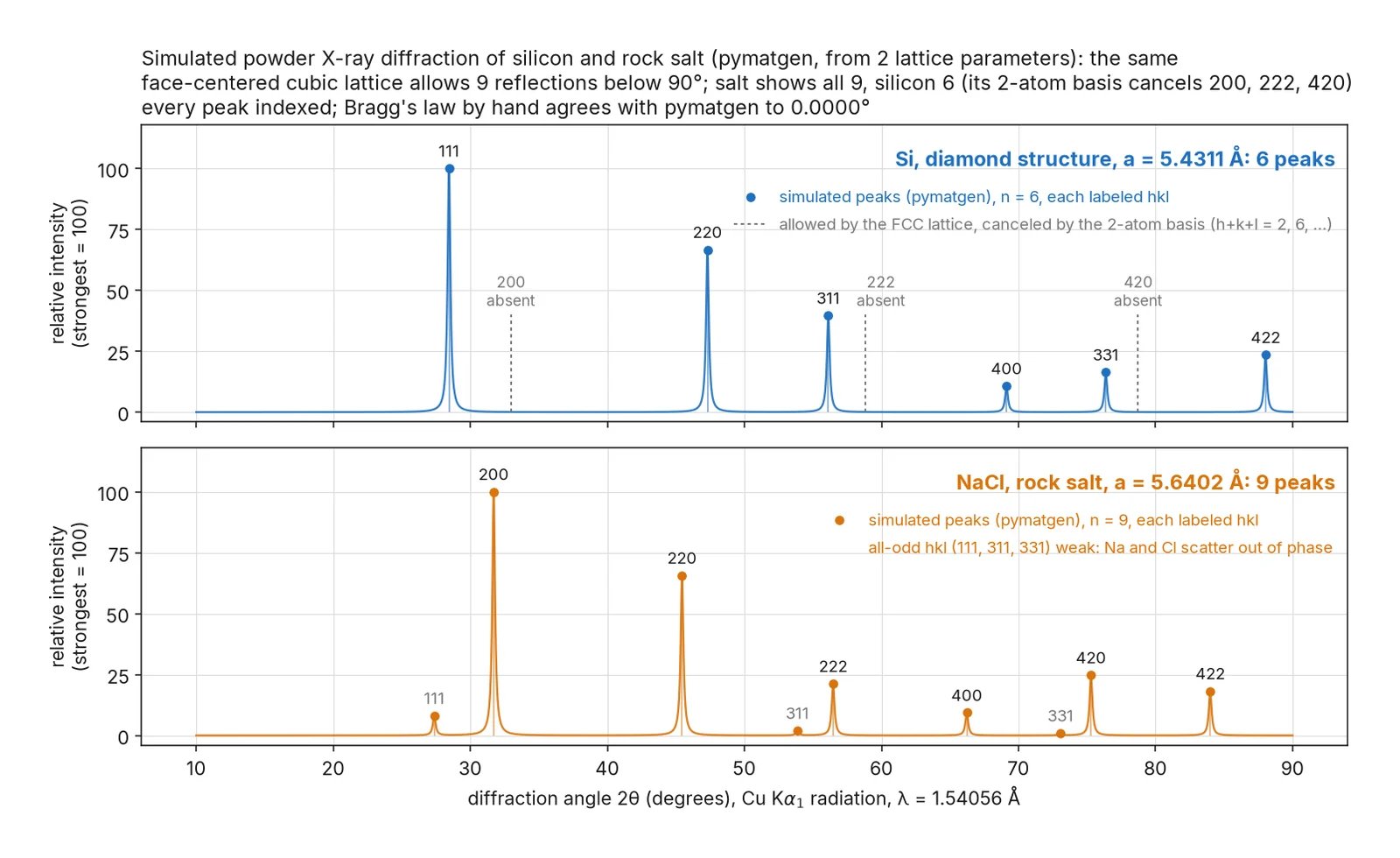
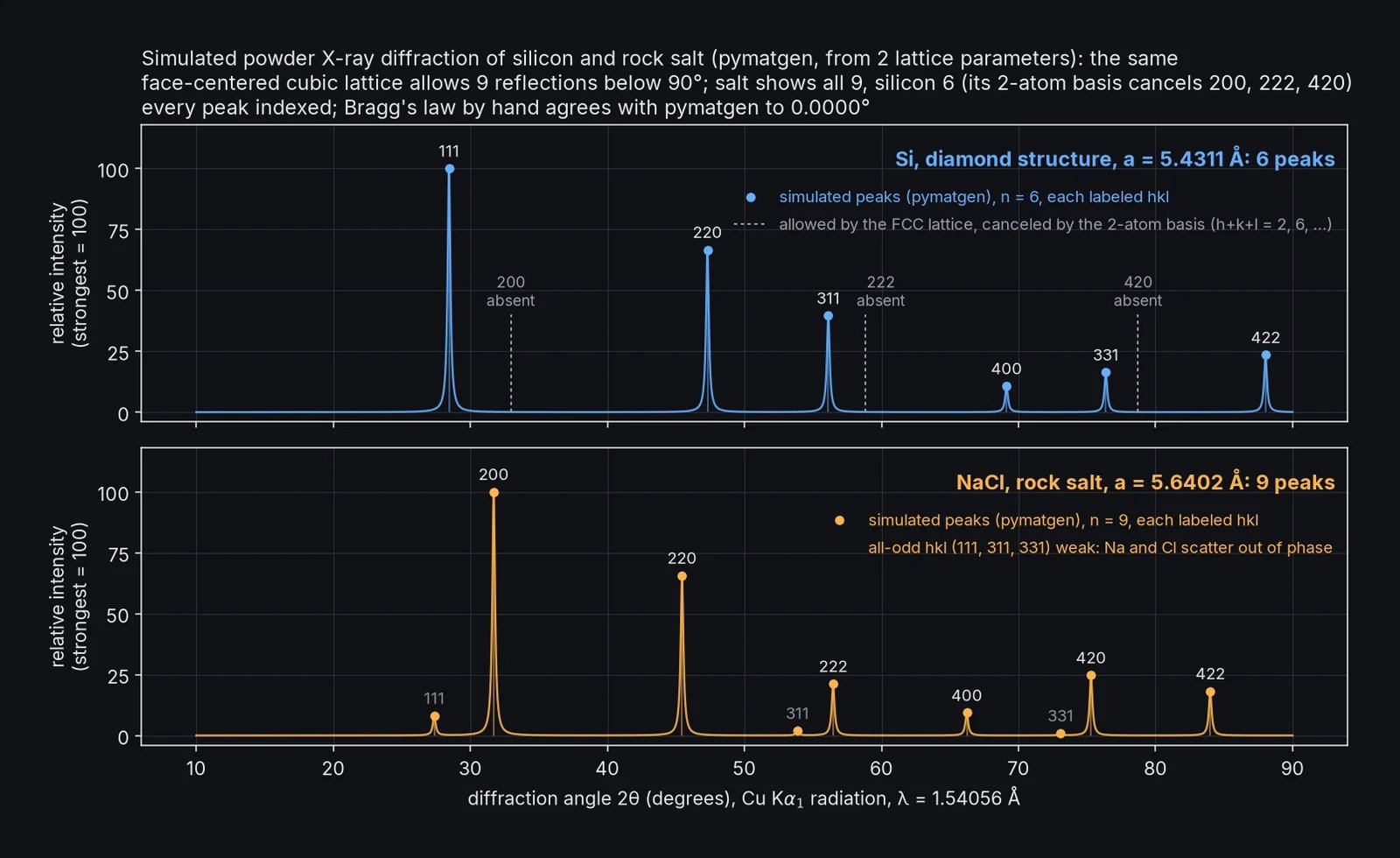
X-ray diffraction is how we know where the atoms sit in a crystal. Simulate the powder diffraction patterns of silicon (diamond structure, a = 5.4311 Å) and rock salt (NaCl, a = 5.6402 Å) with pymatgen, for copper Kα₁ X-rays (wavelength="CuKa1", λ = 1.54056 Å) and angles 2θ up to 90°. Nothing needs downloading. Label every peak with its Miller indices hkl, and check each angle by hand with Bragg's law, λ = 2d sin θ, where d = a/√(h²+k²+l²). Both crystals share a face-centered cubic lattice, which allows 9 reflections in this range, yet silicon shows only 6: show that its 2-atom basis cancels 200, 222 and 420. In salt the all-odd peaks (111, 311, 331) are weak because Na and Cl scatter out of phase: show that too. Leave out other salts and what-ifs such as Na and Cl scattering equally, and round every number once, from its full-precision value. Put both patterns in 1 figure. Explain each step as you would to an undergraduate.
Was this page helpful?