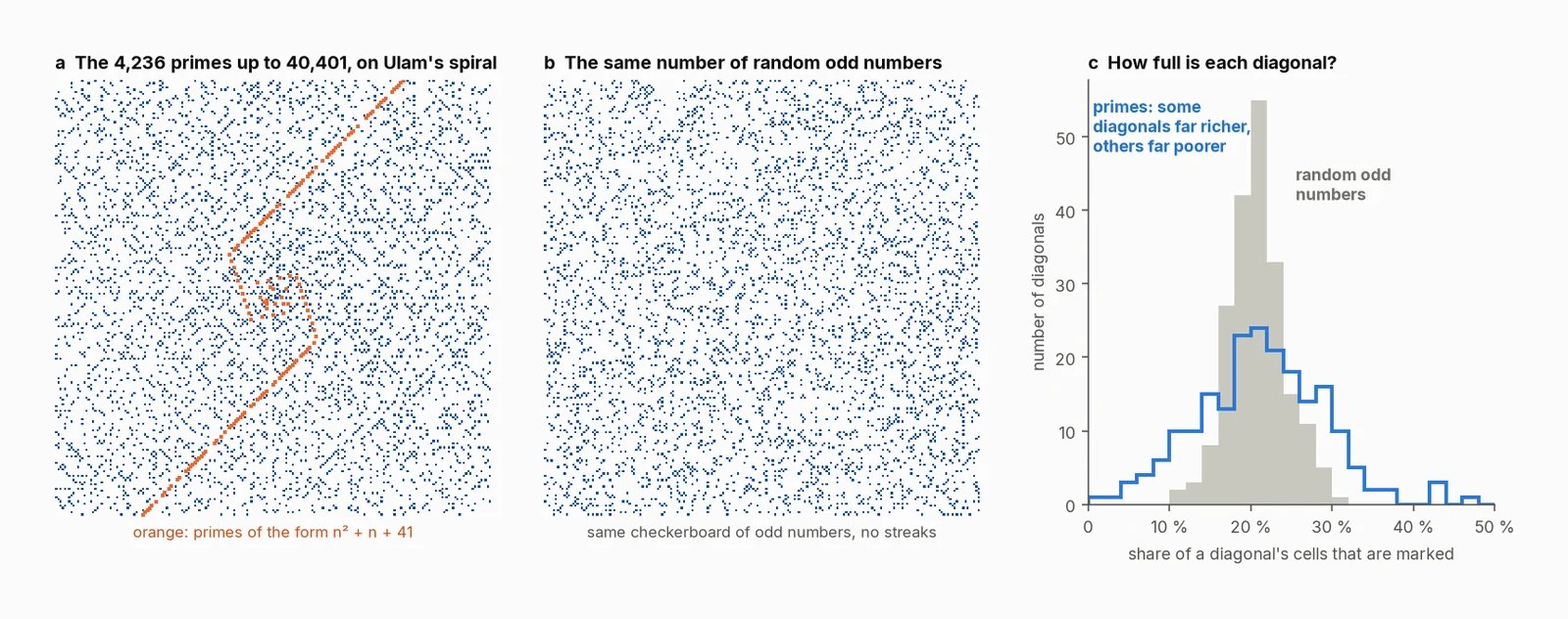
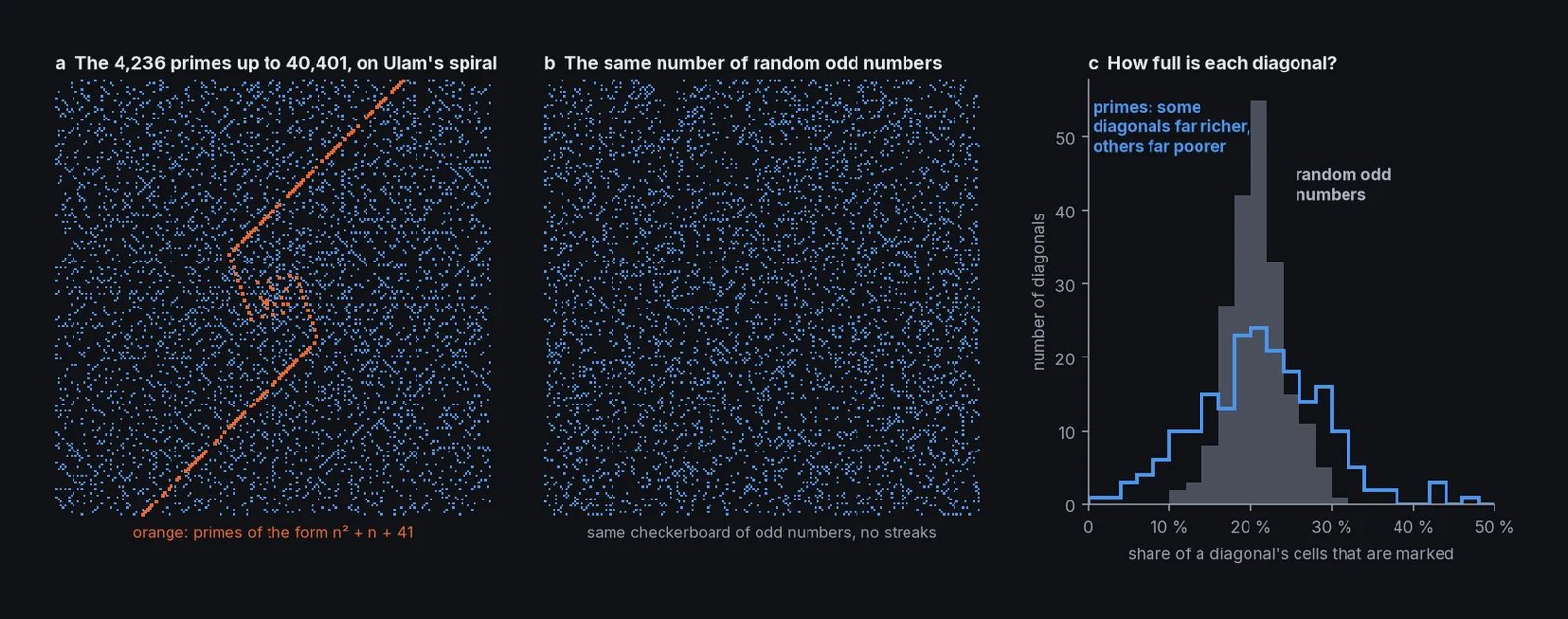
The numbers in your session might differ from this picture and from the summary in Reference analysis.

Prompt

Copy the prompt and paste it into a new session in Claude Science. By default, Claude asks with a permission card before it runs code or installs packages.
Prompt

Reference analysis

Yes. On Ulam’s 1963 spiral of 1 to 40,401, the share of primes per diagonal runs from 0 to 48%, against roughly 11 to 32% for as many random odd numbers. Over the 202 diagonals of at least 100 cells that spread is about 2.3 times the random one, so the streaks are real. The sieve finds 4,236 primes, 1,229 of them below 10,000, as published. Euler’s n² + n + 41 traces the 2 richest streaks (over 70% prime along its 2 rays, each one half of a diagonal, running outward from the diagonal’s cell nearest the center): prime for n = 0 to 39, and for 86 of its first 100 values, where typical odd numbers of that size would give about 29 of 100.

Data

This example doesn’t download any data. Reference: M. L. Stein, S. M. Ulam and M. B. Wells, ‘A visual display of some properties of the distribution of primes’, American Mathematical Monthly 71, 516–520 (1964)