

Every Claude add-in shares one store
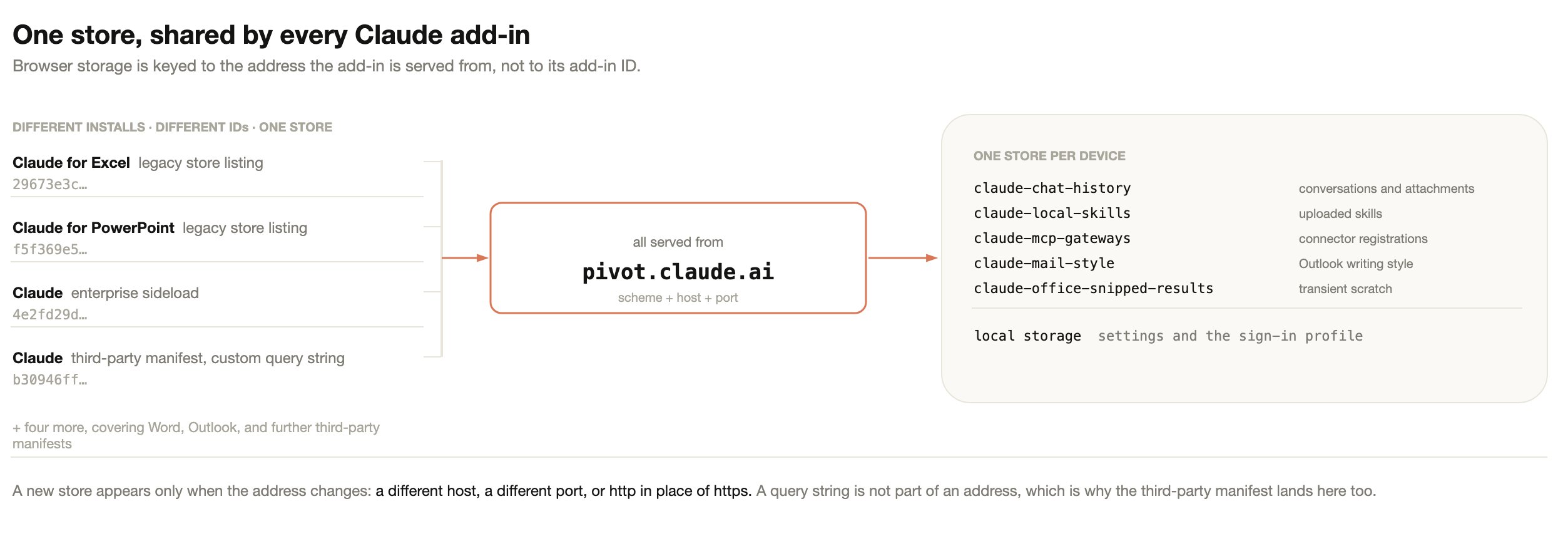
Users run more than one Claude add-in over time: the per-app store listings, an enterprise sideload, or a custom manifest that points the add-in at your own cloud. All of them are served fromhttps://pivot.claude.ai, and browser
storage is keyed to that address. They
therefore read and write the same store on a given device.
<SourceLocation> URL, and opens it in an embedded browser. From that point the
browser behaves as any browser does: it hands storage to the page’s address,
meaning its scheme, host, and port. The add-in’s ID, version, and display name
never enter the lookup, so a manifest is closer to a bookmark than to a
container. Deleting a bookmark does not delete the site’s cookies.
Two consequences follow:
- A query string is not part of an address. A third-party manifest is built for one organization and carries that organization’s configuration in a query string, so no two are alike. All of them still land in the same store as every other install.
- Changing the address does create a new, empty store. Serving the add-in from a
different host, a different port, or over
httpinstead ofhttpsgives it somewhere else to read and write. The previous store still exists, but nothing reads it.
What Claude for M365 stores
The add-in uses five IndexedDB databases and one local storage store, all inside the signed-in user’s operating system profile. The table below lists each one and what it is scoped to.
Conversations and the Outlook writing style guide are scoped to the
individual user. Uploaded skills and connector registrations are scoped to the
storage location instead, so anyone who reaches the same store shares them. The
Windows and macOS sections below describe what splits a store on each platform.
This only applies where people share a single operating system account. That
arrangement already shares the browser profile, saved sessions, and local files
between them, so the guidance is the same as for any browser-based tool: give
each person their own operating system account.
Claude for M365 also writes one value into the Office document itself: an opaque
identifier that lets the add-in recognize the same file after a rename or a Save
As. It holds no user information and no conversation content, and it travels
with the file if the document is shared.
Sign-in and credentials
Every store above holds only content, with one exception. Local storage also holds the signed-in user’s identity: the credential the add-in presents to the model endpoint you configured. Cloud provider sign-ins use short-lived tokens that the add-in renews automatically. A gateway token or API key that you configure yourself is held until you change it. This sits in the browser profile unencrypted, in the same way a saved web session does. The boundary protecting it is the operating system account: another account on the same machine cannot read it, and disk encryption covers the device at rest. Where the deployment signs in to a cloud provider, the credential is obtained on the device and used from the device. A gateway token or API key that you issue centrally is distributed to every user’s device, so treat it as you would any other shared secret.Where the data sits on Windows
On Windows the store is split by signed-in Office account. Local storage is one database for the whole browser profile rather than one per address, which is the main difference from macOS.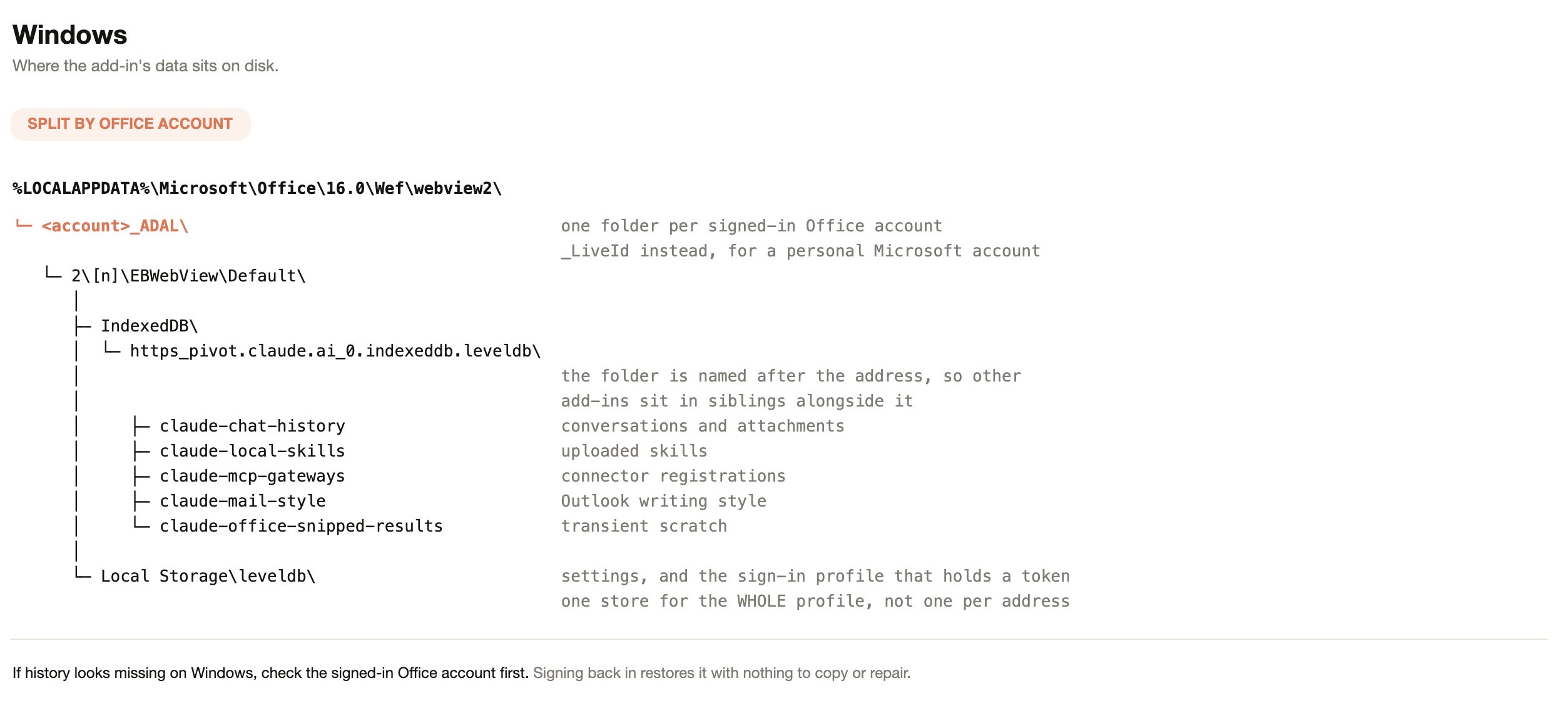
Where the data sits on macOS
On macOS the store is split by Office app instead. Each app runs in its own sandbox container, so Excel, Word, PowerPoint, and Outlook always keep separate histories, and local storage sits inside the folder for a single address.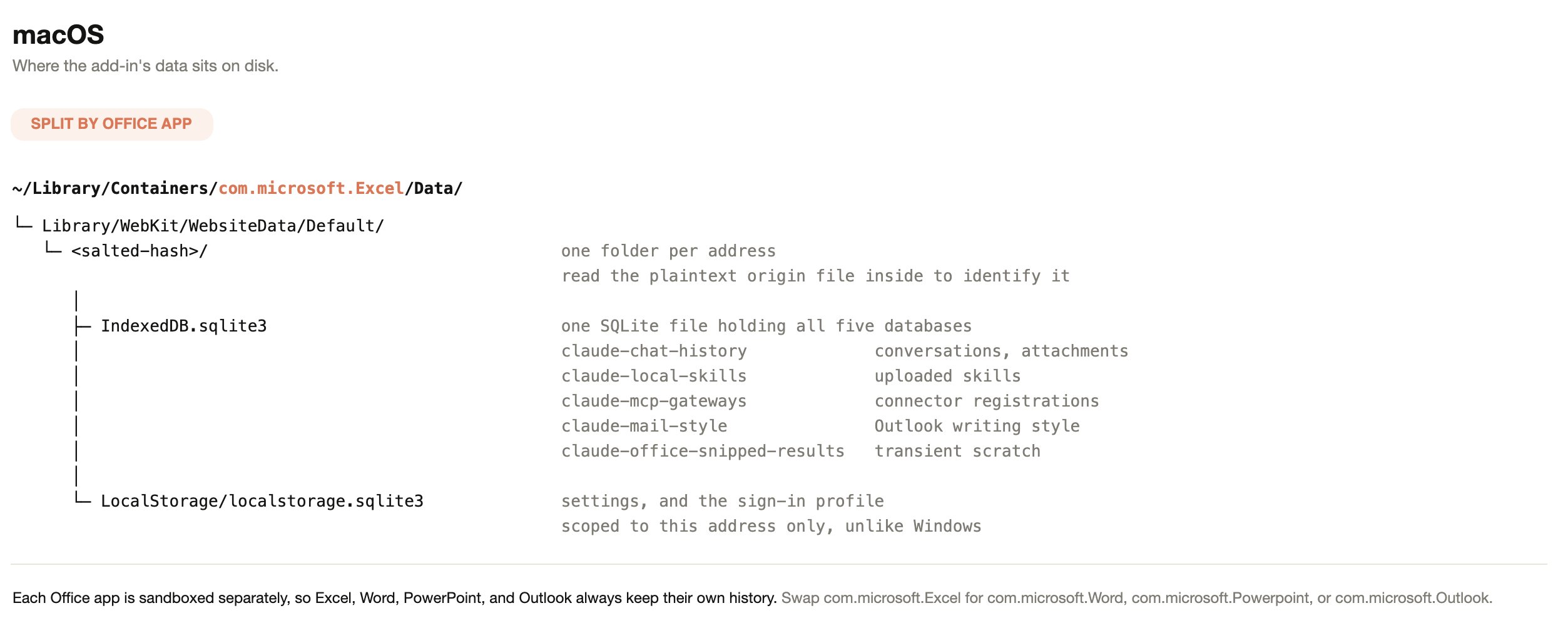
What chat history is keyed to
Sharing a store is not the same as sharing a history list. Each conversation is stored against a user identity, an organization, and the Office app it was created in. The list shows only the conversations that match all three for the session in use. When users sign in with a Claude account, that account is the identity. In third-party platform deployments there is no Claude account, so the identity comes from the Microsoft Entra ID sign-in already present in Office, as a one-way hash of the directory object ID. Nothing about the user is stored in readable form, and the hash is not sent to Anthropic. Office builds without support for nested app authentication cannot supply the Entra ID sign-in the add-in reads. On those builds Claude for M365 falls back to a per-installation identifier. Conversations still persist on that device; they are tied to the installation rather than to the directory account. The table below gives the result for each case.
Changing connection mode is not a data loss event, because nothing is deleted,
but it is an identity change and the history list follows the identity.
One store derives identity differently from chat history. The Outlook writing
style guide has no per-installation fallback. On Office builds where the Entra
ID identity cannot be read, it falls back to a single shared key, so one learned
writing style is shared by everyone using that browser profile.
Data retention
Claude for M365 bounds local storage in two ways, and users can clear it themselves at any time.
Users clear their own conversations from the add-in’s settings. Under “Chat
history”, “Delete all” removes every saved conversation for that user in that
Office app and starts a new chat.
There is no expiry by age and no administrator-configurable retention window.
Claude for M365 also does not inherit custom data retention settings configured
for your organization. If your policy requires a retention limit on this data,
the practical control is the device profile lifecycle, such as roaming-profile
cleanup or reimaging, rather than a setting in the add-in.
What leaves the device
The table below covers each category and its destination, so you can scope a review to the paths that carry content off the endpoint.Export a user’s data before a device is rebuilt
Theclaude-for-msft-365-install plugin includes read-only export scripts for
macOS and Windows. They read Office’s storage and write only to the folder you
name, and running them with no arguments reports what was found without copying
anything. See
Deploy the add-in for your organization
for installation, then run /claude-for-msft-365-install:export-data.
Export before any of the following:
- A device is rebuilt, reimaged, or handed to another person.
- Anyone clears the Office add-in cache on Windows. The storage sits inside the
same
Weffolder as the manifest cache, so deleting that folder destroys chat history along with the manifest. - Roaming-profile or FSLogix cleanup runs against the user’s profile.
- A browser policy such as
ClearBrowsingDataOnExitis applied to the device.